

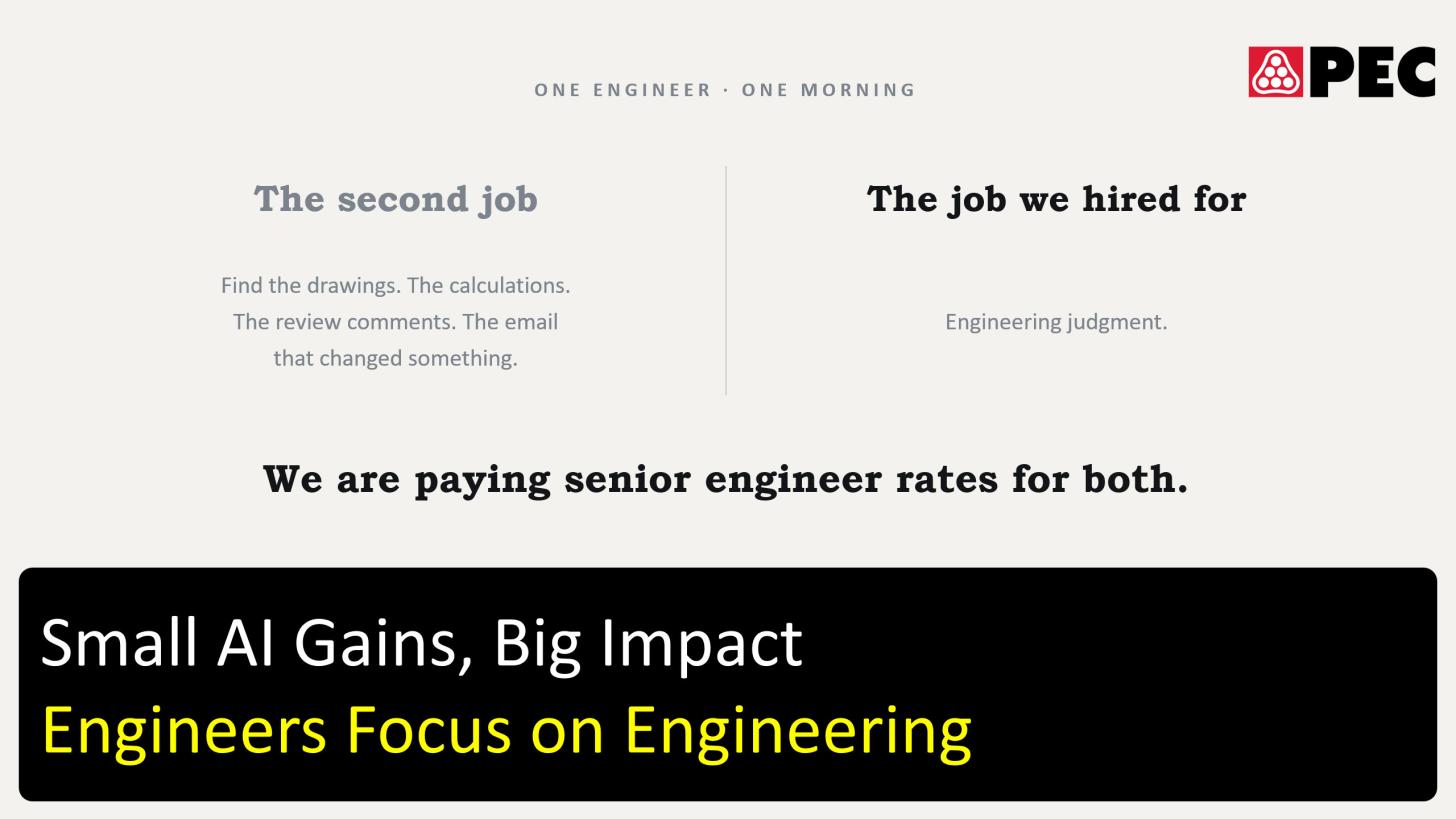
Pop quiz: When is cutting costs or time on a project by 15% considered bad news?
The answer: In conversations about AI, where many people seem to expect multiweek workflows to be accomplished with the push of a button, rather than more practical process improvements.
At least, that’s what AI conversations were like 12 to 18 months ago, when most people were still learning the basics about how to use generative AI chatbots, let alone AI agents. At that time, social media was flooded with people making predictions about how buildings would soon be designed in an afternoon, lawyers and software engineers would all be replaced by AI agents, and we would all be watching custom movies, generated in an instant.
Ironically, as AI tools have become more powerful, expectations have grown more modest. But the technology has also grown far more valuable, at least for those who are using it strategically. The companies leading the way are not spending huge amounts of money on AI with nothing to show for it in the moment, hoping for some future return on their investment. Instead, they are targeting extremely specific workflows, finding ways to save a few minutes here and a couple of hours there.
These are gains that might be dismissed at first as incremental. But across hundreds of projects and thousands of hours of highly skilled work, they can completely transform an organization’s operations.
Professional Engineering Consultants (PEC), a full-service engineering firm based in Wichita, Kansas, provides a wonderful example of how AI use cases grounded in the real world are showing the promise of extraordinary impacts. The firm’s digital transformation team has been looking closely at how engineers spend their time, including not only engineering work, but also all of the ancillary tasks that the work entails.
For PEC, this simple question revealed a massive opportunity. Engineers were spending hours tracking down schedules, drawing sets, and other scattered information to prepare for quality control reviews. These tasks are absolutely necessary, but it doesn’t take a highly skilled engineer to track down a document.
Bobby Goldsberry, Digital Transformation Manager at PEC, quickly realized that this was a perfect opportunity to put AI to work.
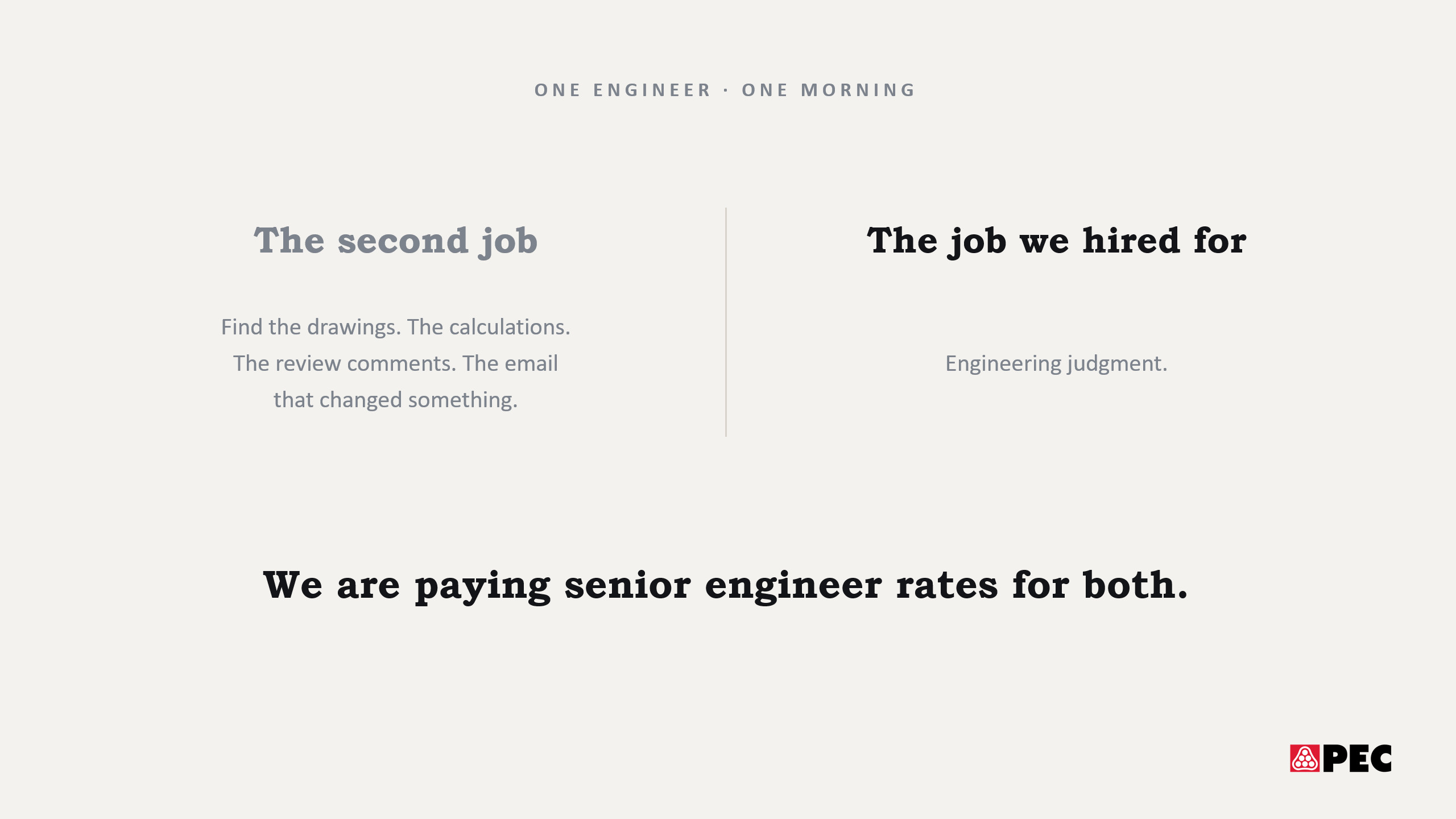
More time to engineer
Giving Time Back to Engineers
Bobby is an enthusiastic innovator, and it is clear from talking to him for even just a few minutes that he brings extraordinary ambition and intelligence to his work. But he is also intensely practical. He is chasing wins that will help the business.
During a recent conversation, Bobby described his role this way:
“My role is looking for the direction the industry is going, aligning that direction with our strategic plan, and then finding opportunities to address problems. I’m looking for the repetitive tasks, places where engineers spend most of their time on a daily basis.”
Bobby also emphasized the importance of giving engineers more time to focus on clients:
“We essentially sell time. So, the more time that we can gain back for our engineering staff, the more they can focus on our clients.”
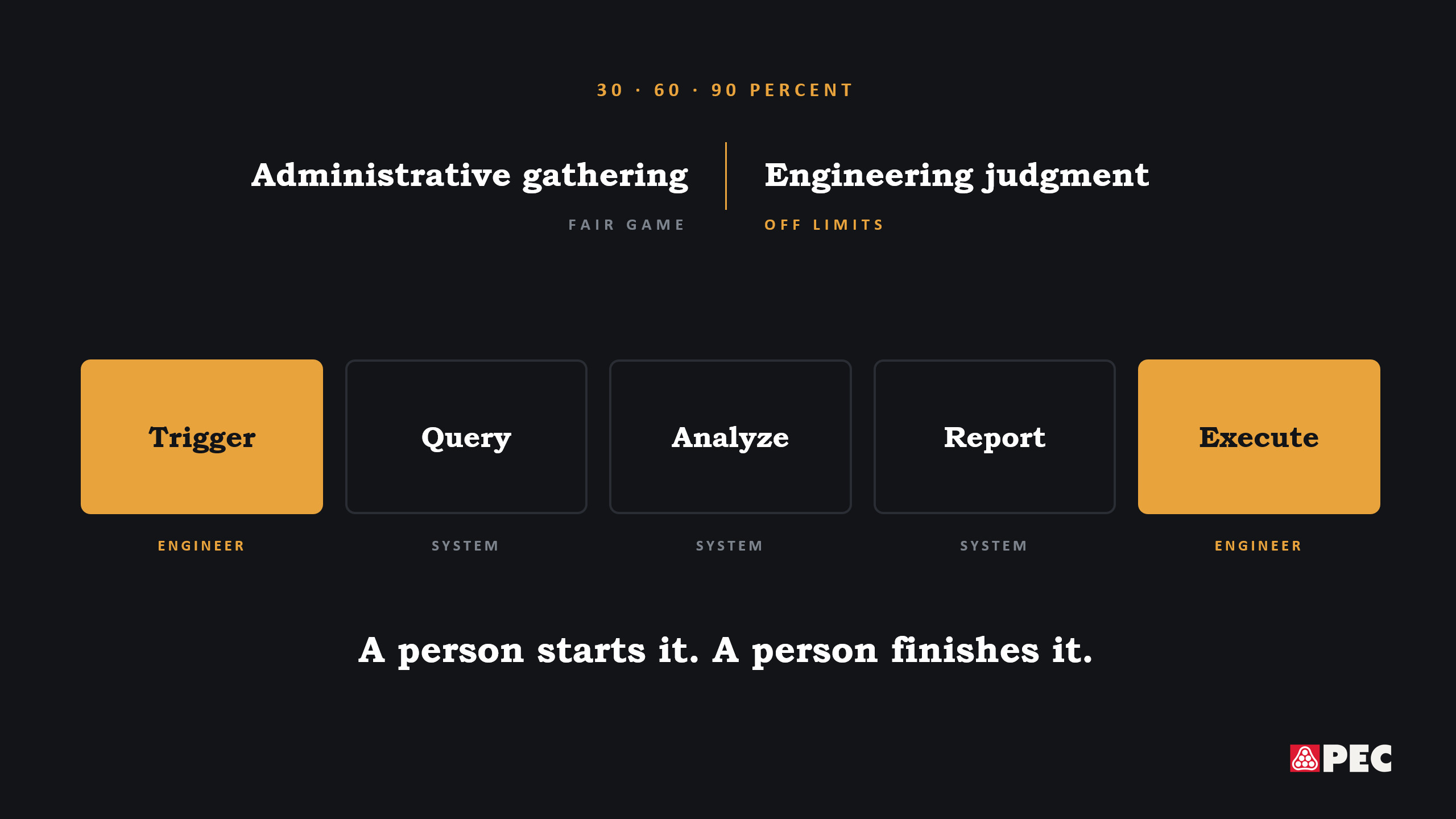
Humans start and finish
Bobby’s investigation into how engineers spend their time quickly led him to the quality control process. Before engineers could even begin reviewing whether a project was ready to advance from the 30% project completion milestone to 60% milestone, or from 60% to 90%, they often had to spend significant time hunting down all of the relevant project documents. Bobby and his team consolidated information that had previously been split between cloud platforms and on-premises repositories. Then, using Autodesk Platform Services, the team built an MCP server that allows an AI assistant to query all of this information.
This means that engineers can essentially ask questions of the project itself. For example: What items from the 30% review remain unresolved? Who is responsible for those items? How does the current project schedule align with our quality control checklist?
The system can also draw on meeting transcripts and other project records, dramatically reducing the time engineers spend searching for information before they can begin their real work. Bobby explained why reducing this cognitive burden matters:
“We only have so much executive function capability in our day-to-day lives. For our engineers, finding all of this information isn’t worth spending that capacity. We’re putting time back in their hands.”
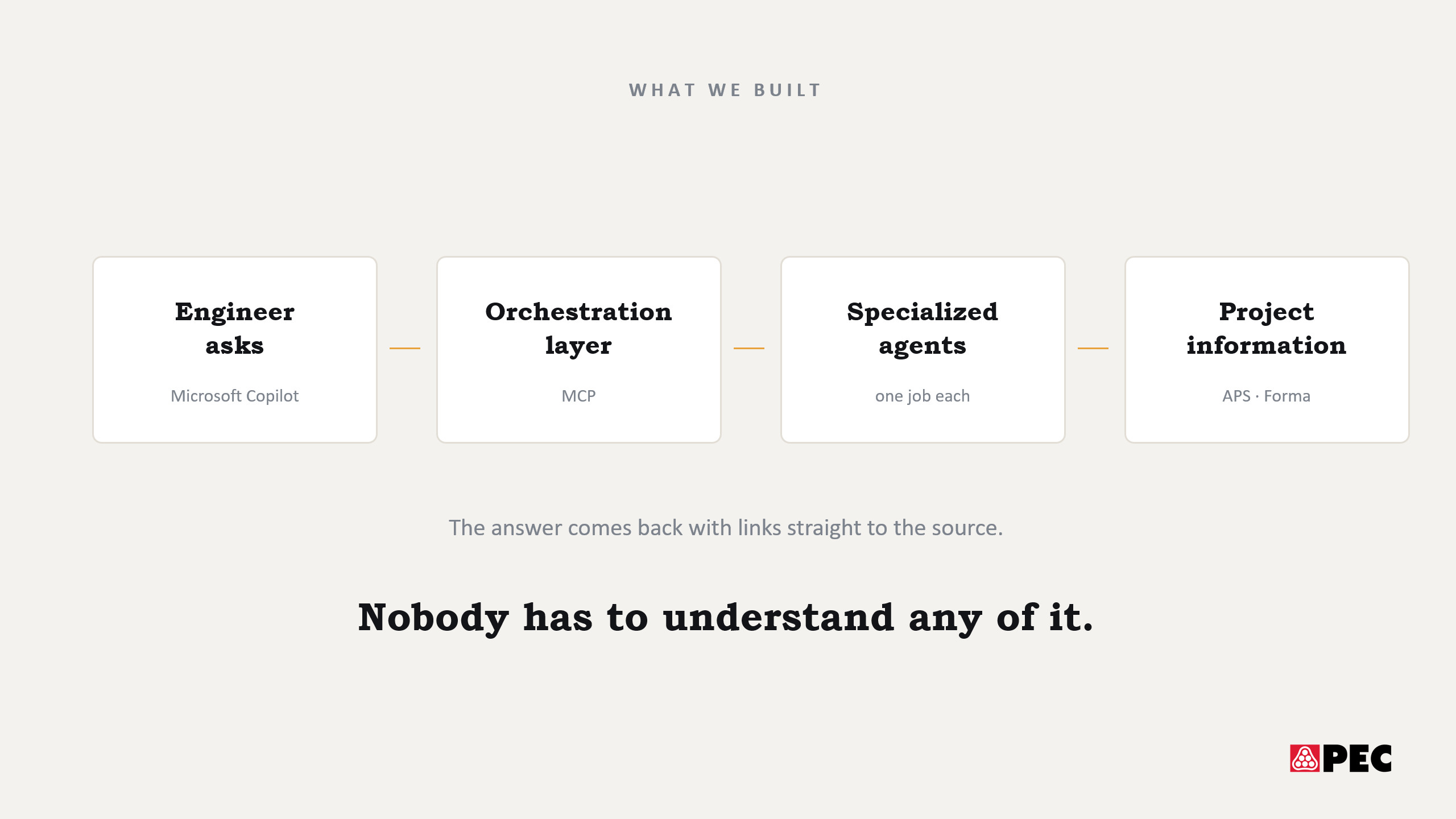
AI handles the middle
The Path to AI Maturity
Bobby estimates that the new system can save roughly an hour per project. (The system is still in beta, used on around 10% of projects.) It is also helping prevent previously identified quality control issues from falling through the cracks. For example, on one project, an engineer flagged a drawing discrepancy related to a voltage requirement on a piece of equipment. As the project progressed through the stages of quality control, the AI system recognized that the problem had been identified, but no resolution had been documented.
In the final stages of quality control, Bobby told me, review materials may sit in a queue for several days, depending on an engineer’s workload. But then, once the engineer is finally able to devote his or her attention to the final review, they often discover that they’re missing some vital piece of information, forcing the review to be shelved again until the correct document is located. Bobby expects the AI system to significantly reduce this sort of process downtime.
To ensure accuracy, PEC is keeping the AI tightly bounded to the organization’s own project information, configuring the system so that it only draws from specified project folders and data sources. PEC is comparing AI-generated reports against underlying project information, and then tweaking the system if it produces inaccurate or ambiguous responses. Bobby described PEC’s approach to accuracy this way:
“We’re trusting but verifying. Fortunately for us, engineers are pretty skeptical by nature.”
Bobby’s team is also looking closely at the economics of the solution. The goal is to be able to communicate exactly what the system will cost in token consumption, and to connect that expense to a specific return. Bobby explained how the team is controlling those costs:
“If we just open it up and it queries every single folder for every single project, we can’t control our token spend. So we’re trying to create the rules where it only goes to a certain location and runs queries one at a time.”
Looking ahead, Bobby envisions similar AI solutions to assist with tasks like proposal writing, email triage, and other information-heavy workflows. But the ultimate goal, he said, is to make the business more efficient, not to simply build exciting new solutions. Bobby described that goal in practical terms:
“We do not have a strategic goal of trying to build more AI tools. It’s really just focusing on where our engineers are spending most of their time, and asking: Is there an opportunity for an AI agent to help save 10 to 15% of that time?”
Bobby summed up the shift in PEC’s approach to AI this way:
“The AI novelty has worn off. We’re looking for practical solutions.”
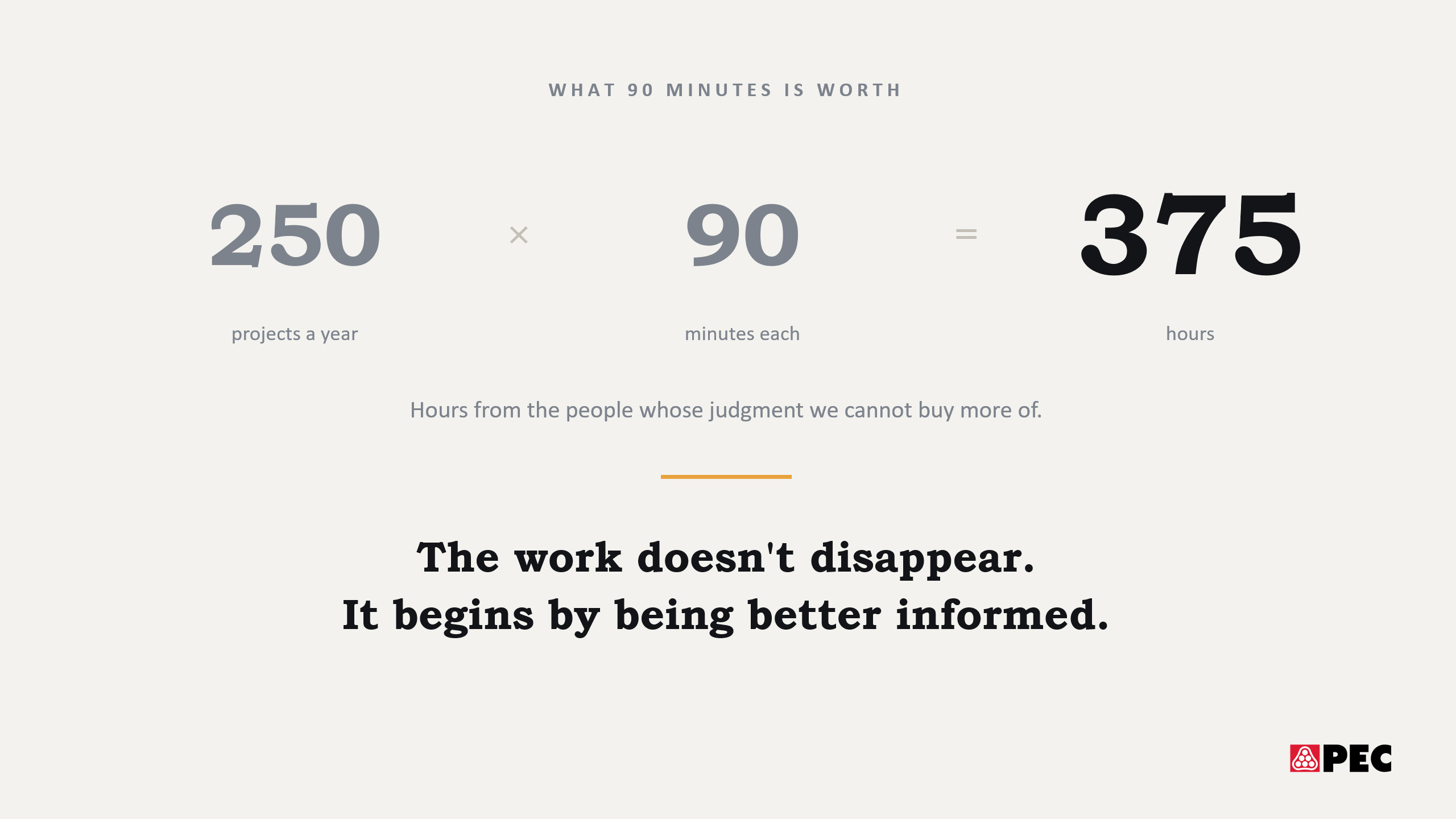
90 minutes, 375 hours
Bobby also shared his perspective at Autodesk University's Platform Leadership Forum, discussing how PEC is moving beyond the AI hype to focus on practical solutions that give engineers more time to do what they do best.
A Question for You
PEC’s practical example brings up some (possibly uncomfortable) questions for engineering firms:
- Are we trying to “boil the ocean” with our AI pilots, and overlooking the value of small, repeatable wins as a result?
- If an AI workflow can save 10 to 15% of engineering time on a process, is that merely an incremental improvement, or does it produce a meaningful competitive advantage when scaled out?
- Which engineering tasks should we apply AI to first: the most complex ones, or the ones that require the least engineering expertise?
I would love to hear where you’re seeing the biggest opportunities for AI in your own firm! Are you currently using AI tools to replace expert work, or more to protect the time of your engineers so they can focus on that expert work themselves?