

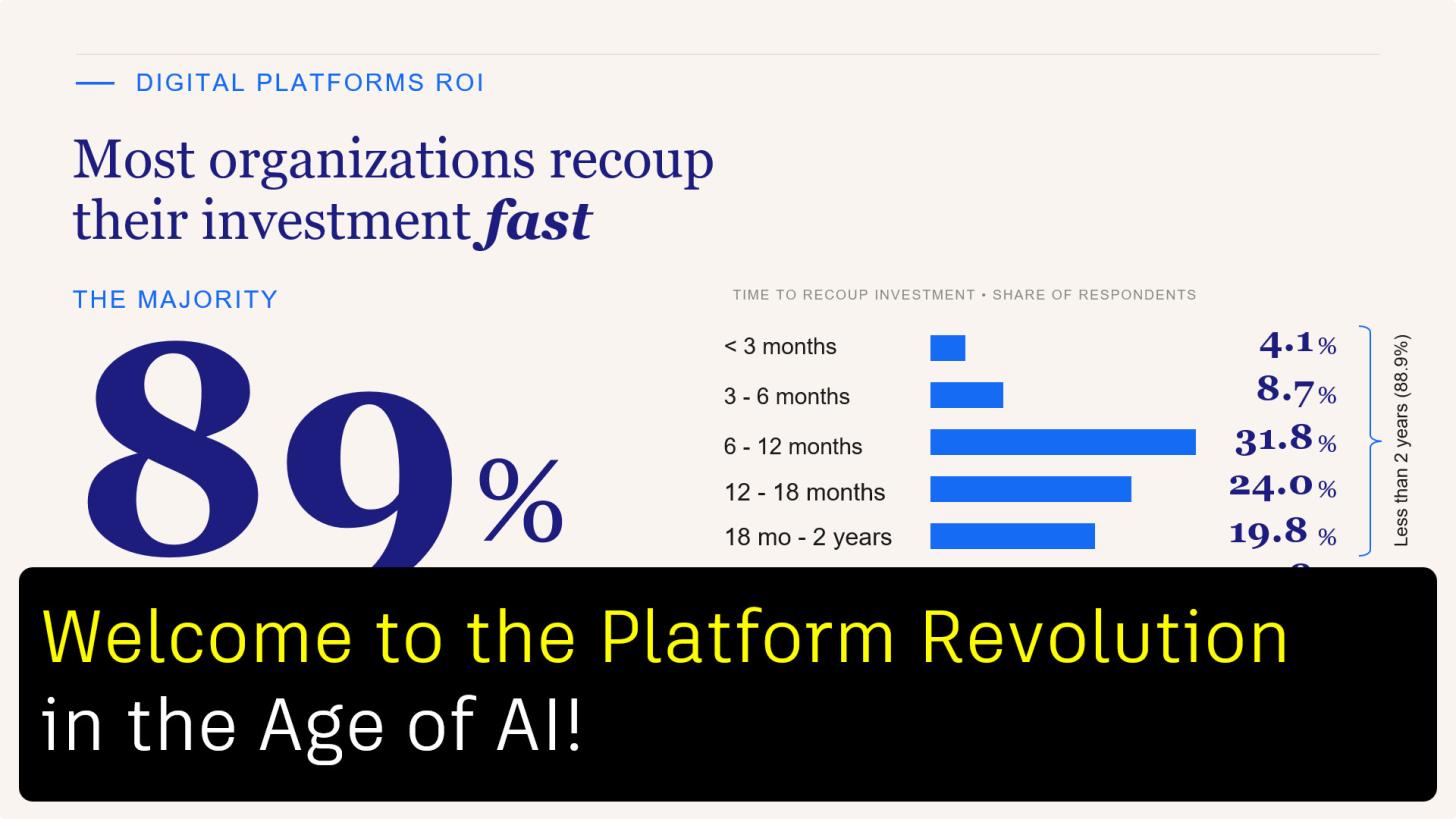
Last fall, the day before Autodesk University in Nashville, 700 people packed into a Music City Center🎸 auditorium, with more lining up in the hallway trying to get inside to watch a presentation called “The Platform Revolution”.
Nadia Ballard, Sr. Research Manager, Industry Cloud and SaaS at IDC, shared insights during our Platform Leadership Forum. Listening to her talk, I learned that what we’re seeing at Autodesk in the design and make fields is also playing out across all industries. Namely, people are rapidly moving away from standalone software tools and embracing platforms that bring together data and capabilities from a number of separate systems. Ballard told the crowd:
“For software users, it’s getting easier than ever to feel productive and in control of your workflows and tools. With AI, nontechnical users can now automate complex tasks, reduce manual effort, and streamline decision making. The modern digital platform is what makes these shifts possible.”
IDC has a wealth of research on the topic, all of which was illuminating. But more than anything, one finding stood out to me. According to IDC, 45% of organizations are seeing a return on their platform investments within just one year, and another 44% say that platforms pay for themselves within two years. **
These numbers—combined with the excitement in that Nashville auditorium—signaled to me that we’re even further along in the platform revolution than I previously thought.

Platform Leadership Forum, Nashville 2025
Platform or Perish
We are advancing Autodesk Platform Services (APS) to meet the evolving needs of the industry today and in the future, while better serving our partners and customers. With APS, developers can use APIs to extend and customize Autodesk tools, automate manual workflows, and integrate business systems. For our developer partners, this helps accelerate development and reduce go-to-market time by showcasing their solutions to customers and breaking down data silos. And our users see productivity gains because the platform eliminates need to constantly switch between different environments.
More broadly, Ballard said, the push toward platforms is being driven by twin forces. On the vendor side, companies are realizing that AI tools are beginning to replace traditional SaaS solutions.
“Because AI agents only need the underlying data, they can be software-agnostic. That means that vendors of standalone software tools can expect more churn and market share erosion. The directive is clear—become a platform, or perish.”
But this isn’t just a vendor-led market shift, Ballard said. She noted that the fall of “walled garden” software means that users no longer have to navigate the often cumbersome path between separate environments.
“Think of a typical customer service call where you have to repeat your information every time you’re sent to a new department. Customers expect a smooth experience. They don’t want to click through six or seven different systems.”
In fact, according to an IDC survey of business leaders, improved customer satisfaction is the top benefit of platforms, followed by operational efficiency and employee productivity. **
Julia (Eremeeva) Brun, Business Development Manager for AMER at Autodesk and one of the key organizers behind the platform leadership forum, supports our developer partners’ business needs. She told me that the customers she spoke with were eager to learn how to connect Autodesk to their other software tools.
“Autodesk is at the heart of their business, but other tools like financial systems also contain critical data. They’re asking how they can connect all these business-critical systems together in an open platform, instead of having siloed features.”
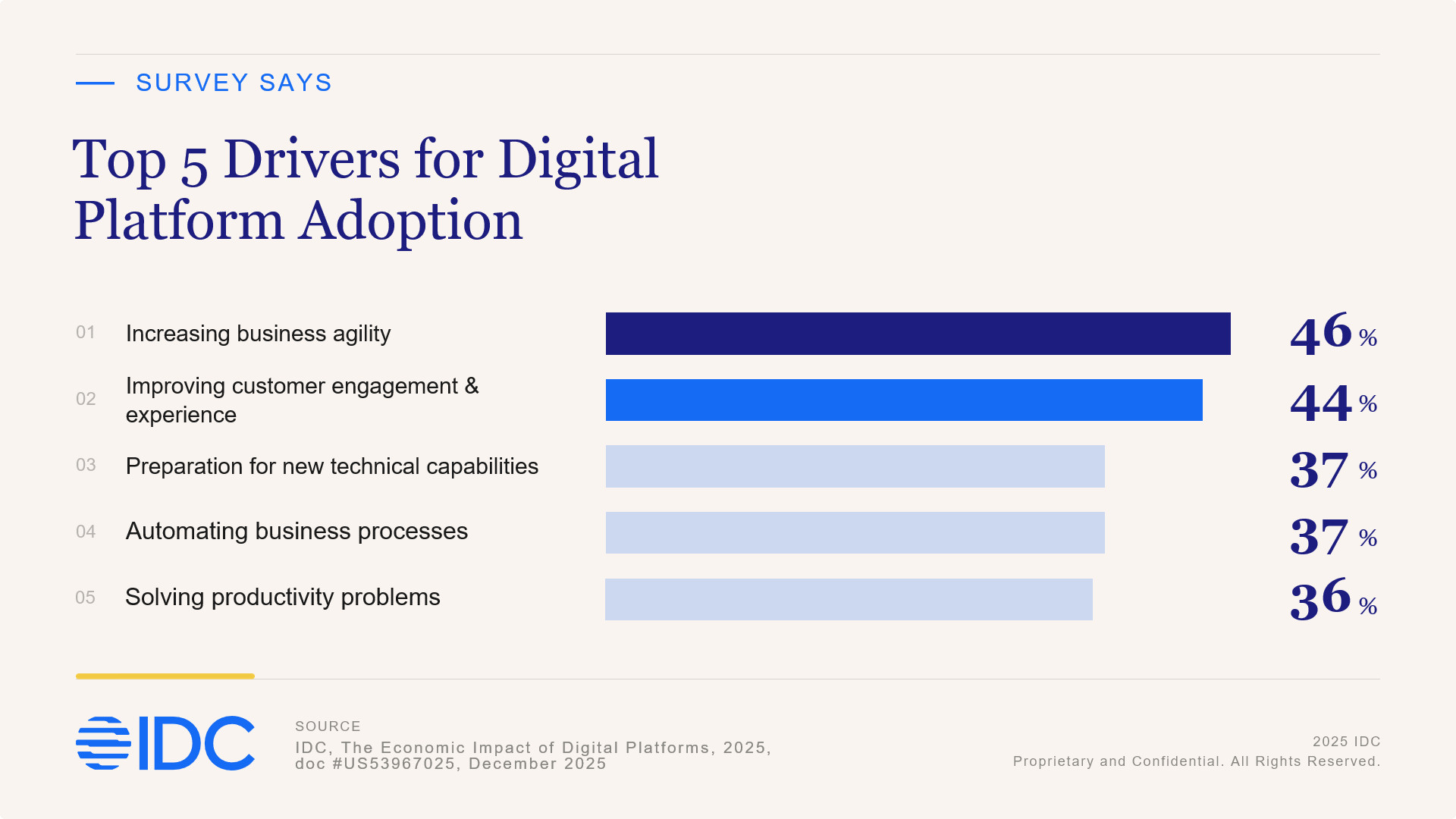
Top Drivers of Platform Adoption **
Making the Shift
Even though vendors and customers are naturally moving toward a platform approach to technology, Ballard pointed out that there are still hurdles to adoption.
When IDC asked business leaders what vendors can do to remove adoption barriers, the top response centered on data quality, security, and compliance. ** Ballard shared:
“If data is not clean, it is not trusted. Add in AI hallucinations, and trust goes way down. Organizations know that they need to put their data houses in order—including governance, testing, and security—to resolve this low-trust issue.”
In IDC’s survey, respondents also said vendors can improve adoption by simplifying integration and reducing technical complexity, investing in comprehensive training and customer success, and supporting change management and organizational alignment. **
Here again, I saw the work we’ve done with APS reflected in Ballard’s talk. For instance, our Authentication API allows applications to securely access user data across different services without directly handling user credentials. Thousands of our partner applications rely on this trusted APS service every day to deliver a scalable and secure environment to customers.
Even as Ballard listed the barriers to adoption, my mind kept returning to the ROI numbers. The vast majority (89%) of business leaders told IDC that they were seeing a full return on their platform investments within two years **, so it’s clear that they are seeing success despite these obstacles. But, as Ballard stressed, not all platforms are created equal:
“It can’t just work in the demo. It has to be a modern platform that is purpose-built, and open, and modular. It needs to be easy for partners to build on so it can keep changing as new needs arise. And it has to give users more flexibility and more autonomy.”
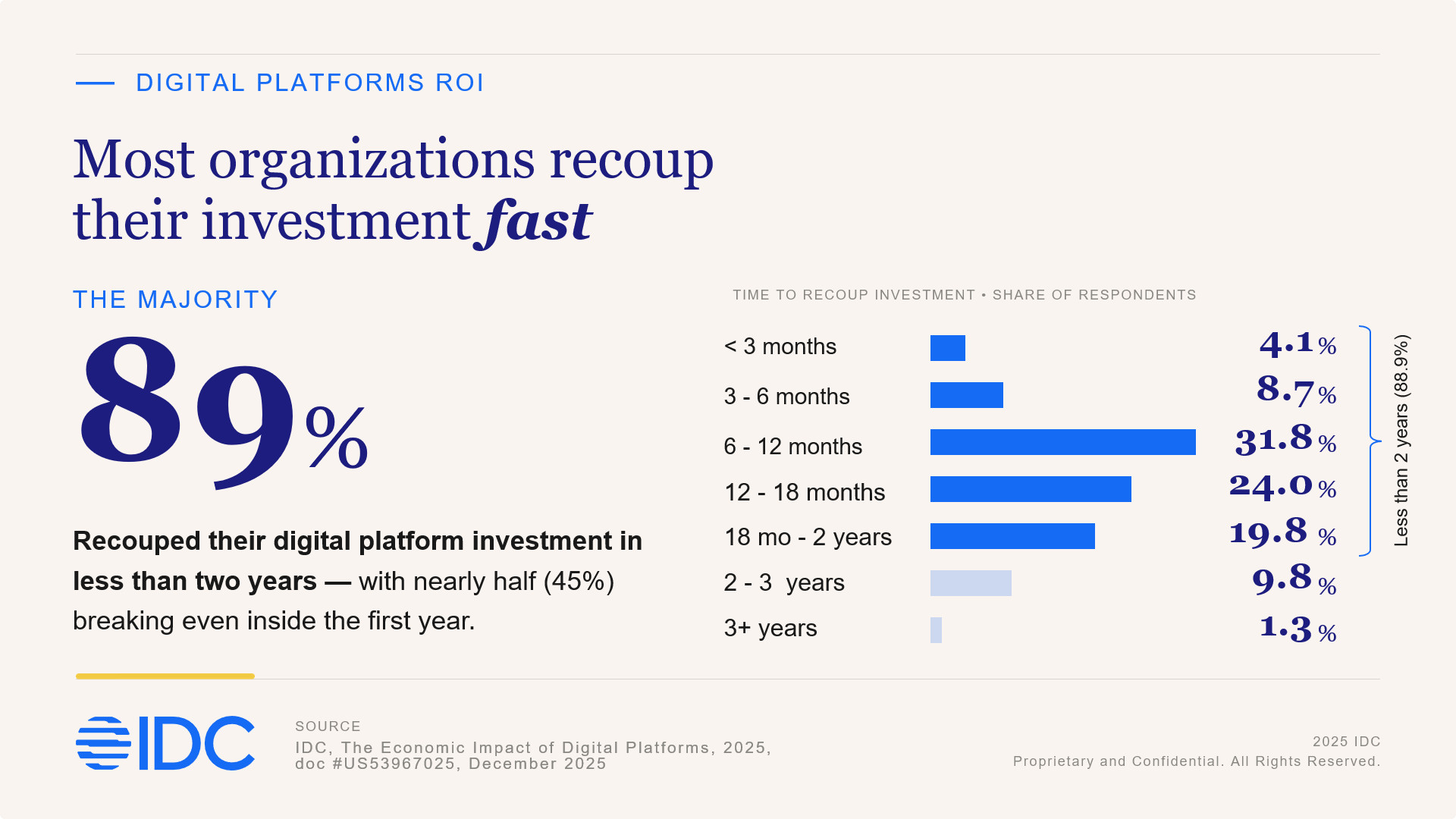
Digital Platforms ROI **
Why Platforms Are Accelerating AI
Earlier, I mentioned how Ballard told the audience that the rise of AI is pushing vendors to move away from standalone SaaS tools and toward a platform approach. But, she added, platforms are not just a consequence of AI—they are a prerequisite for it.
“You can’t have well-functioning AI without a well-functioning platform.”
This view wasn’t just Ballard’s opinion. Rather, this conclusion was also reflected in IDC’s survey data. More than half of business leaders said that platforms provide user-friendly tools for designing and customizing autonomous agents, improve the real-world performance of deployed agents, and enable collaborative development and version control for agentic AI projects. And just under half agreed that platforms enhance agent capabilities by offering robust integration with external data sources. **
Ballard listed a number of other surprising ways that platforms and AI intersect. For example, she noted that small, industry-specific LLMs are often “smart” enough to work with imperfect data sets—potentially eliminating one of the top barriers to platform adoption.
Ballard noted that the AEC companies tend to be “fast followers,” rather than trailblazers, when it comes to new technologies. But she added that these organizations will need to adopt both platforms and AI tools quickly to keep up.
“There are so many moving parts in this industry, and it’s impossible to make a tool that does everything. With a platform, smaller contractors can access the two or three systems they need, and then the architects can access the entire ecosystem. Platforms are a way to ensure that everybody is singing from the same sheet of music.”
Navigating the Platform Economy
Ready to understand what the platform revolution means for your organization?
- Explore IDC’s Infographic, The Platform Economy: How Digital Platforms Are Reshaping Markets.
- Join the Platform Leadership Forum at AU 2026 in Las Vegas (September 14, 2026) to learn how AI and platforms are transforming the Design and Make industry—and beyond.
SOURCE
** IDC, The Economic Impact of Digital Platforms, 2025, doc #US53967025, December 2025