

For decades, the ring road 🛣️ surrounding Antwerp, Belgium has been more of a semicircle, broken up by the port city’s waterways. That has created a mobility bottleneck that forces 150,000 vehicles each day to navigate a tangle of surface streets throughout the city, leading to regular traffic snarls.
The €10 billion Oosterweel Link project will finally close that loop with 18 kilometers of new infrastructure, including multiple tunnels threading beneath both the Scheldt River and existing neighborhoods, where construction is happening almost literally in residents’ backyards. The scale of the project is breathtaking—requiring, for example, the construction, transport, and underwater placement of eight 60,000-ton tunnel segments.
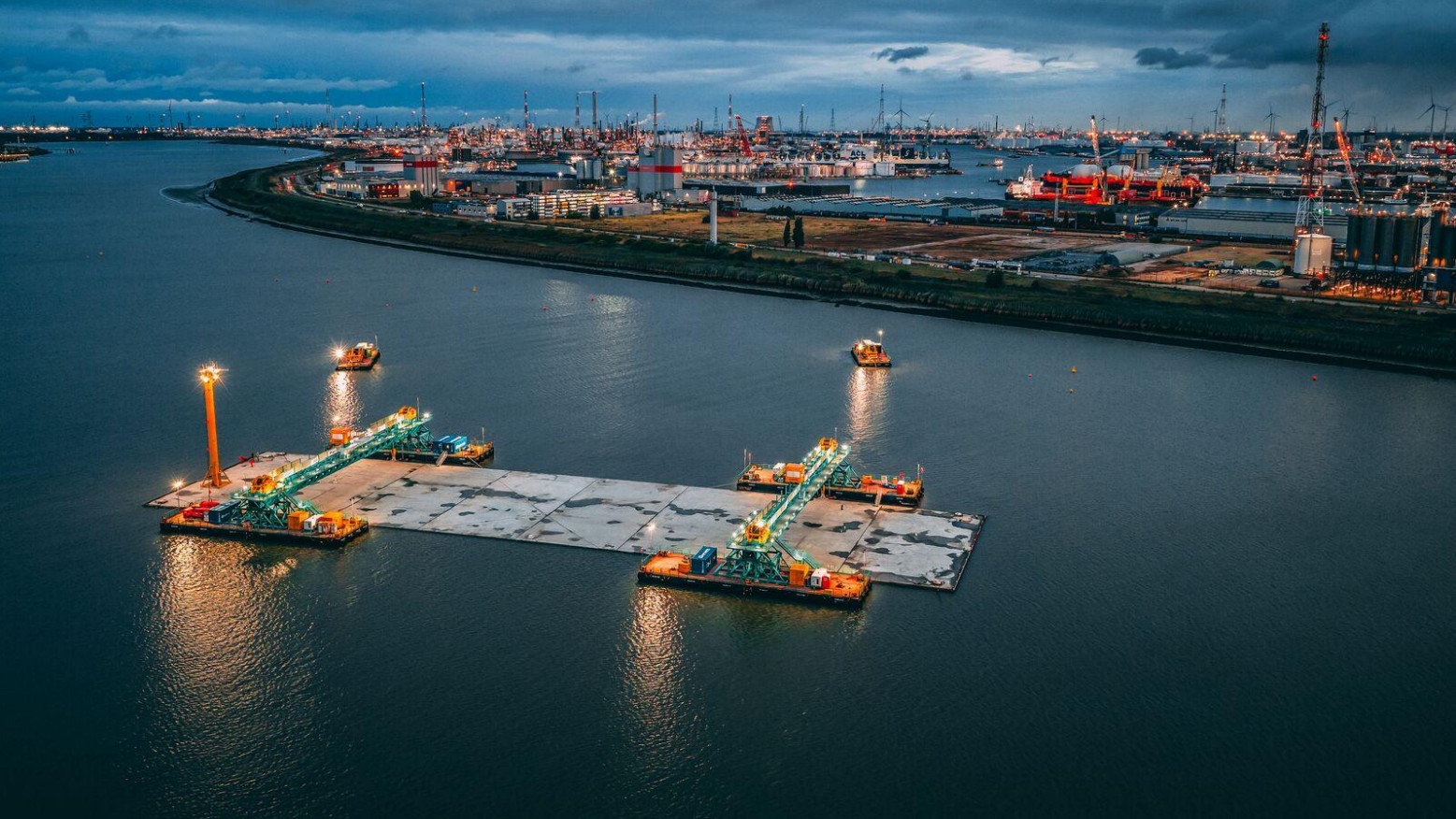
Shipping prefabricated components by water reduces on-site disruption
The Real Bottleneck: Fragmented Information at Massive Scale
When I visited Lantis, the government organization coordinating this enormous undertaking, I expected to hear them talk about the technical challenges of constructing and installing massive underwater tunnel systems. But instead, project leaders largely spoke to me about the difficulty of coordinating 5,700 different contractors, making sure they all have access to the data they need to collectively create infrastructure that is meant to last for a century or more. As Frederic Van Hoorebeke, Chief Financial Officer at Lantis, told me:
“The challenge is that most of our contractors focus on their part of the work. Of course, you need to split things into pieces, but then you need to bring things back together. And the biggest challenge in bringing everything together is the sharing of information. We have far more data than we had in the past, and it seems contradictory, but that huge amount of data makes collaboration even more difficult.”
To tackle this challenge, Lantis brought together 150 professionals from across the contractor ecosystem at the 'Lantis Digital Gamechangers' event. Instead of only meeting peers at scattered industry gatherings, this initiative created a local space for real collaboration. It went beyond tools and workflows—focusing on how everyone, from C-suite leaders to BIM managers and IT specialists, contributes to the bigger picture of the Oosterweel Link project. As Yanissa De Jonghe, Head of Digital & Data at Lantis, put it:
“Technology is, of course, a vital part of the project. But the real challenge lies in bringing people together—aligning mindsets and creating a shared way of seeing things. That’s what makes the ‘Lantis Digital Gamechangers’ event so important to our work.”
Partners and Platforms
Just as the Oosterweel Link will create a physical hub connecting Antwerp’s ring road, Lantis needed to build a digital hub to connect data from thousands of contractors. Rather than building everything from scratch, project organizers decided to focus on three core technology partners that all emphasize an ecosystem approach.
One of these is Autodesk. Lantis uses Autodesk Forma (Formerly ACC, Autodesk Construction Cloud) as its central repository for all design and construction data, including drawings, models, and project files. To connect that data with other systems, Lantis relies on Autodesk Platform Services, which provides APIs that can extract both file metadata and detailed properties from within the project data and drawings themselves. The Forma APIs unify project data, automate workflows, and unlock long-term value across organizations—for instance, by extracting budget data for use across different systems.
The other two strategic partners are
- Esri – powering geospatial data and mapping, and
- Microsoft – providing the data lake with Azure, Fabric and insights through Power BI.
As Yanissa noted:
“We chose our strategic partners because they are taking a very ecosystem way of thinking, with APIs that can connect anything to anything. That’s what we need. Lantis has almost no data ourselves, without our other partners in our ecosystem, because most of it is delivered by our contractors. Also, the data doesn’t mean anything if we don’t get insights from it. And if we don’t work with parties that have an ecosystem way of thinking, we cannot make that happen.”
From Manual Reporting to Automated Intelligence
Thierry Janssens, Data Architect at Lantis, told me that this need to unify data from disparate sources was key to building out the IT ecosystem for Oosterweel Link. He explained:
“The APIs are very important, because there will never be a tool that will cover everything. The Holy Grail will never exist, so what do you do? You choose the right products that fit the need, and you make sure that you can easily get the data where you need it to be. Autodesk is extremely good at this.”
The transformation so far has been dramatic. Previously, generating complex reports from Autodesk Forma required an engineer to complete several manual steps and run a Python script—a process that took up to 30 hours end to end. Today, using Autodesk Platform Services APIs, Lantis has fully automated this workflow, shrinking the same process down to just 20 minutes.
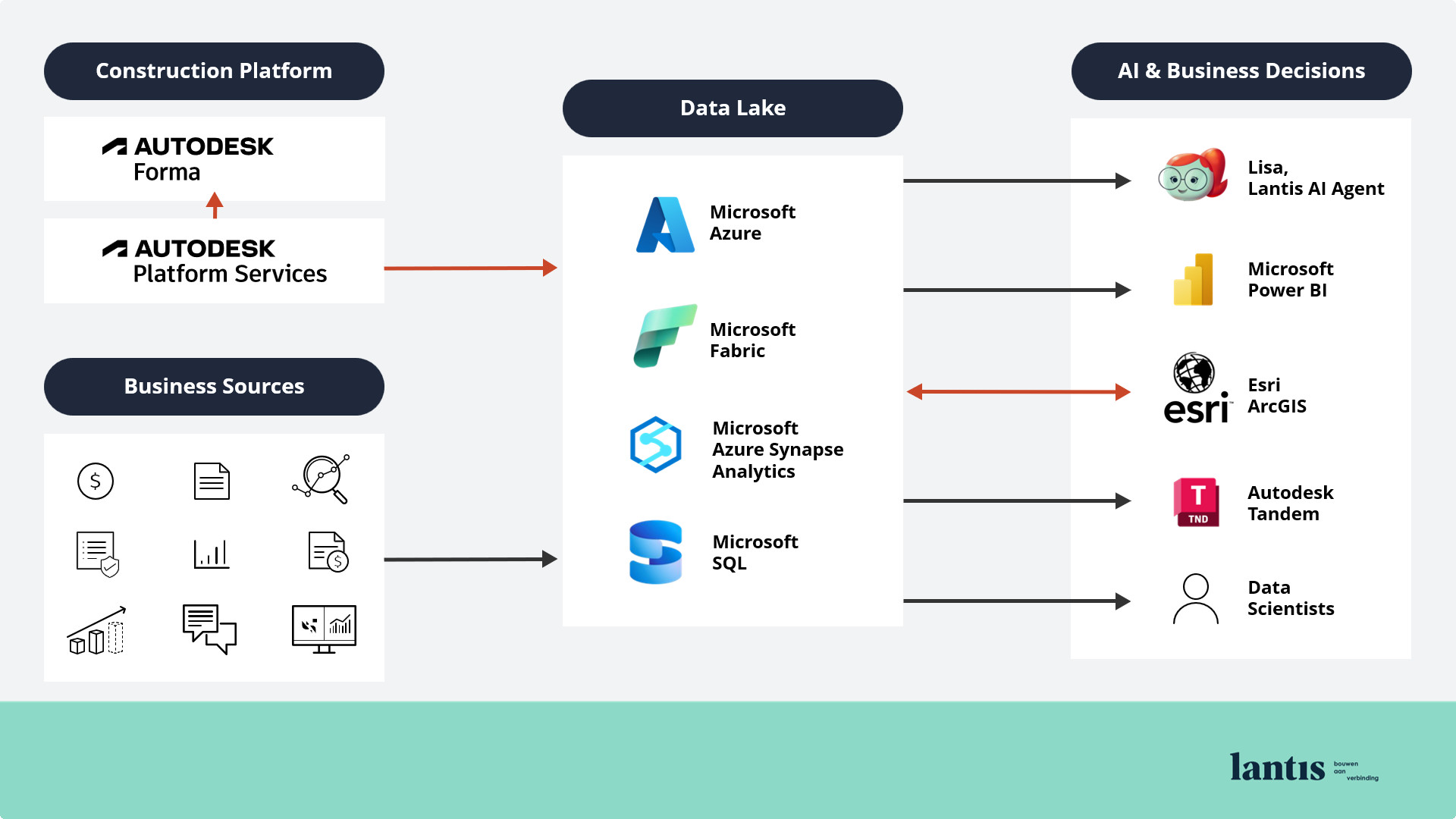
Lantis Data Platform (LDP)
Steps Toward a 100-Year Solution
While the three-partner approach created a unified technology ecosystem, it was the 'Lantis Digital Gamechangers' event that began to nudge contractors toward a more collaborative way of working. It’s been a gradual process, De Jonghe told me, and the mindset shift is far from complete. But the event succeeded in elevating this conversation beyond IT departments to the executive level, where strategic decisions about data sharing actually get made. Yanissa said:
“We faced the challenge that our contractors were not as digital-first as we were, and an ecosystem can only work if we are on the same level. The technical people at the contractors were already convinced, but the 'Lantis Digital Gamechangers' event helped bring a broader set of stakeholders into the game. At some point, you need a mandate to go forward.”
The key, Frederic told me, is getting stakeholders from the traditionally conservative construction sector to think about long-term innovation and collaboration, in addition to immediate outcomes. He put it into perspective:
“Most companies focus on the short term. It’s not easy for people to do things differently from what they’re used to. The real value is not within the next 10 years, but instead lies in the next 100 years.”
AI as an Accelerator
The Oosterweel Link is scheduled to be completed in 2033, and project organizers are already thinking about how to operate and maintain the infrastructure for decades into the future. This means that Lantis must not only optimize construction processes, but also maintain detailed data on every asset to be used over the project’s entire operational life. The organization is already deploying AI tools that can surface technical specifications, cost data, and related documents for specific project components, without requiring expensive engineering talent to hunt through different databases.
As a younger organization without legacy systems to work around, Lantis has been able to design its digital ecosystem specifically for longevity. Frederic noted:
“We can start from a clean sheet. For us, the future is far more important than the past.”
Yanissa recently expanded on this at the FORTUNE-hosted AI Leadership Forum at DevCon, highlighting how AI is enabling smarter decisions and greater scalability across infrastructure projects.
A Question for You
If your organization works with hundreds—or thousands—of partners, and struggles with fragmented data, ask yourself:
- What would be possible if your entire ecosystem was connected, automated, and AI ready?
- What would you automate first?
- What insights are locked in silos today?
If this resonates, I’d love to continue the conversation. The future of infrastructure will be built not just with concrete and steel, but with platforms, data, and AI.