

More than 40% of large 🇪🇺 European companies had already adopted AI by 2024, but smaller organizations and companies in certain industries are still catching up. Europe is leading the world in reducing carbon emissions, but much of this decline is driven by the power sector and reductions in industrial emissions, rather than by green initiatives such as electric vehicle adoption. And while the cloud continues to drive digital transformation, cloud adoption remains under 50% among European enterprises.
These are just some of the eye-opening findings from “Transformation in a Time of Global Change,” a business briefing from the Economist Intelligence Unit (EIU).
The EIU is the research arm of The Economist, and it has a long track record of producing widely respected global research. Its report highlights the global trends driving business transformation, providing an independent perspective to help businesses better understand what is already happening in the market and prepare for what comes next.
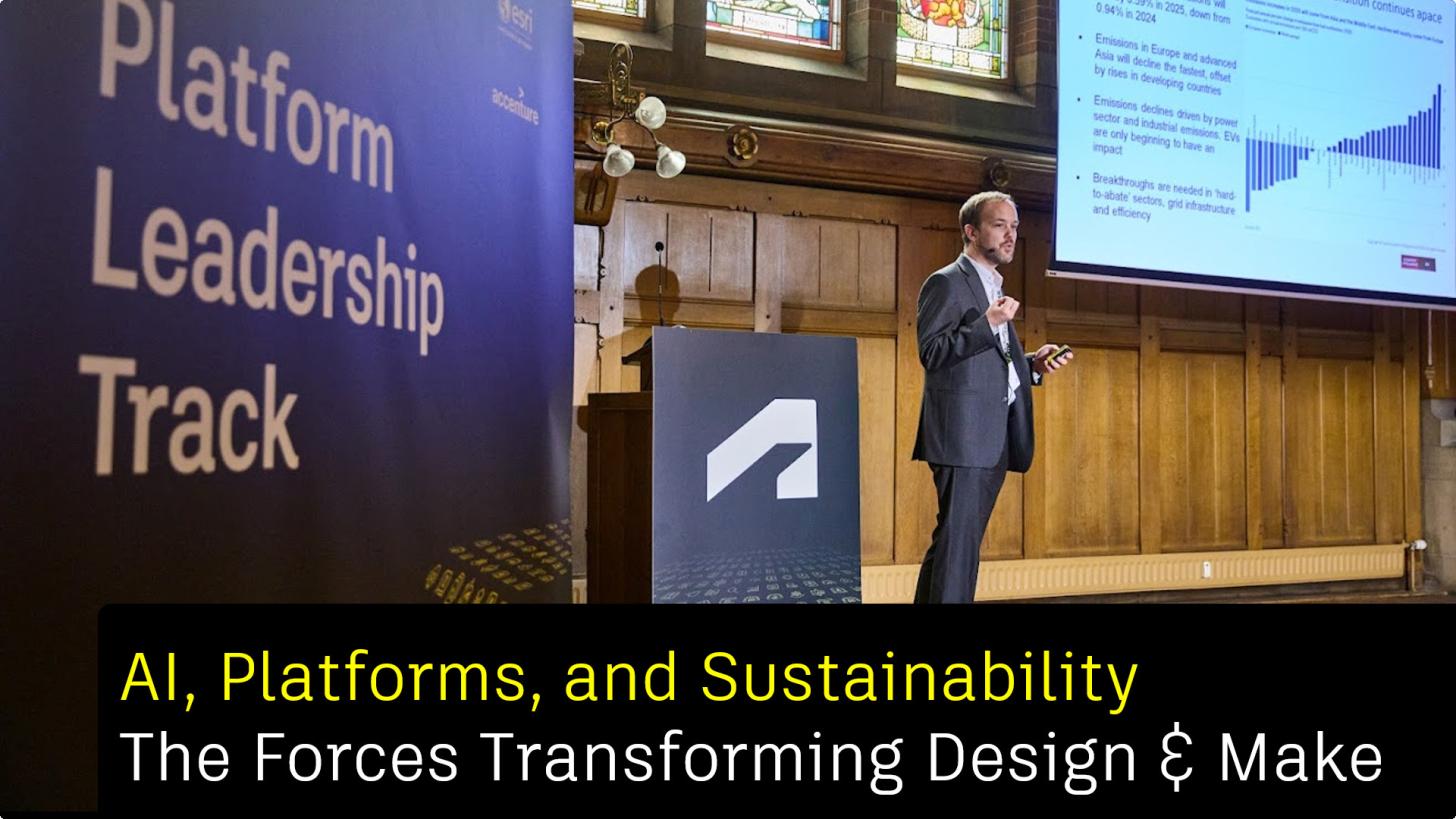
EIU experts presented their findings at last year’s DevCon, Autodesk’s annual ecosystem event that connects customers, partners, and industry thought leaders to accelerate AI innovation, build strategic partnerships, and drive business growth.
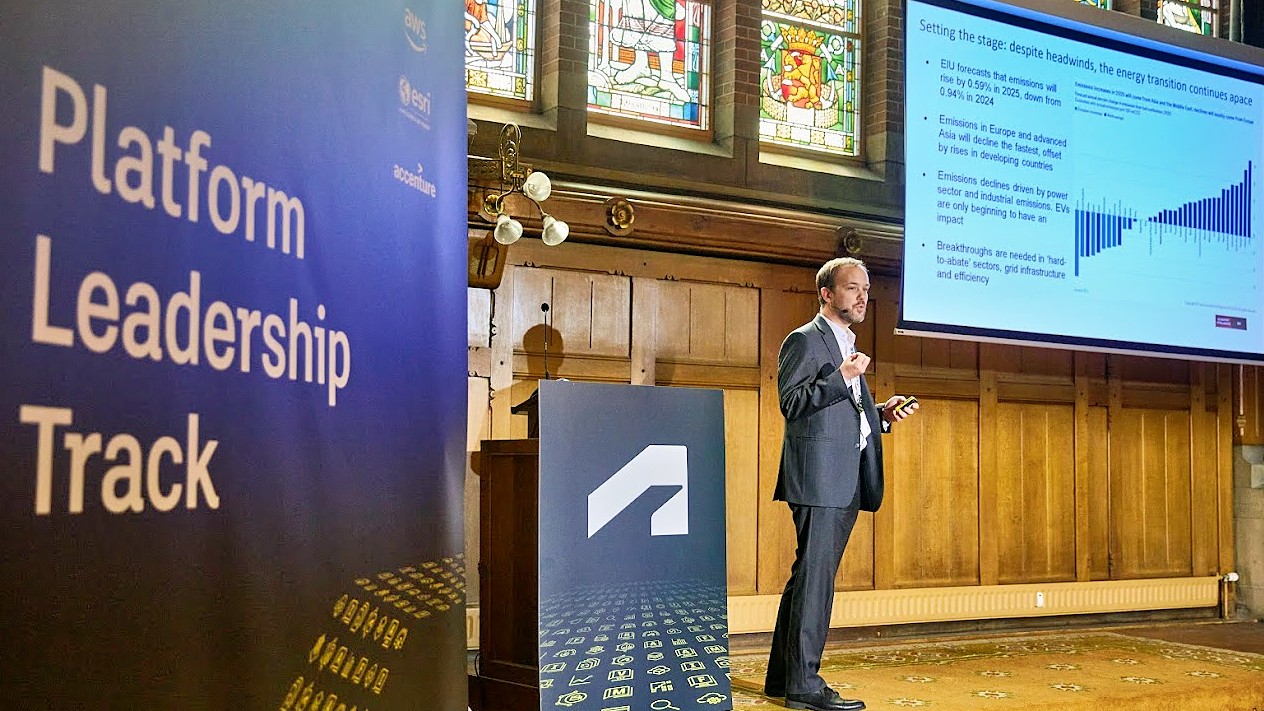
Platform Leadership Track at DevCon, Amsterdam
with insights from the Economist Intelligence Unit (EIU)
AI: Gaining an Edge on Competitors
For those of us who are chained to our laptops and constantly reading tech headlines, it can seem like the entire business world has already begun using AI tools to accelerate workflows and improve productivity. However, the EIU notes that only 13.5% of European companies were already using AI in 2024.
Surely, that number has since increased dramatically. Still, the EIU’s research illustrates the enormous opportunity here, especially for smaller organizations and companies in fields that are taking a comparatively cautious approach. Nearly half of information and communication companies in Europe had already adopted AI in 2024, along with more than 40% of large businesses. But the AI adoption numbers were much smaller in manufacturing (11%) and construction (6%), as well as for small and medium-sized businesses across industries (11%).
So, even though companies are already using AI to create tremendous value, the EIU’s findings show that manufacturing and construction firms still have an outsized opportunity to be early adopters in their field and create a competitive advantage. Dexter Thillien, Lead Analyst for Technology at EIU, explained during his presentation at DevCon:
“There are two ways to look at it. Only 13.5% of companies are using AI. What are you doing? Or, 86.5% of companies are not using AI, and there’s an awful lot of opportunity.”
In its business briefing, the EIU noted that it is often best to start with smaller AI applications and then scale up. The EIU wrote:
“There must be a clear use case, which is only possible by understanding a customer’s pain points in order to provide targeted solutions. The solution must be driven by outcomes, not by tech.”
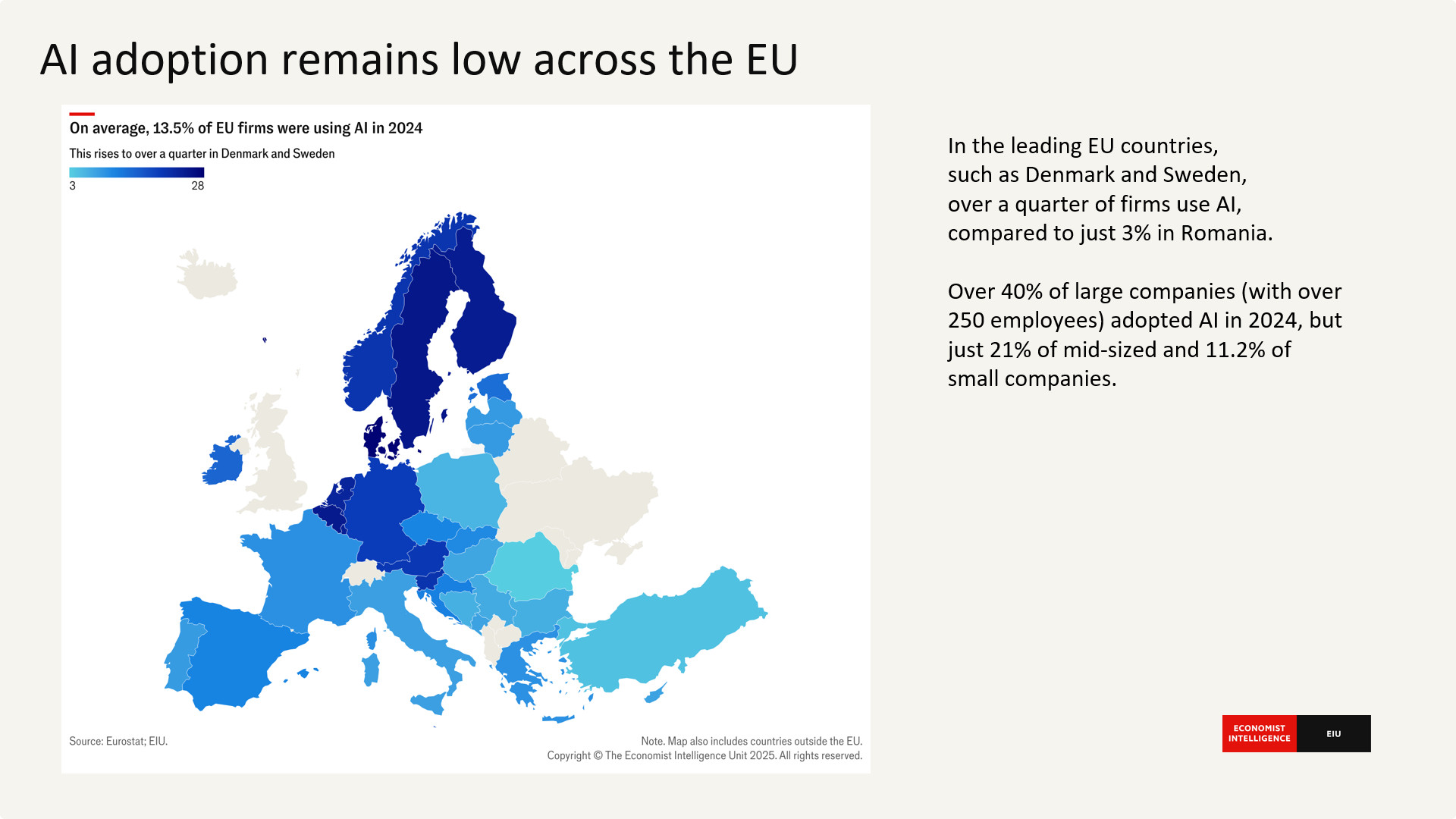
AI adoption remains low across the EU
SOURCE: Driving Business Transformation in a Time of Global Change, The Economist Intelligence Unit, EIU
Sustainability: Preparing for Tomorrow’s Reality
During his presentation at DevCon, Matthew Oxenford, Lead Analyst for Climate Change and Sustainability at the EIU, made it clear that Europe is leading the way on sustainability. He said:
“Europe’s key value proposition is to accelerate the green transition and pioneer technologies, so that when [other countries] are in a position to adopt greener technologies, they will already be available and proven.”
The EIU reports that 32% of green tech startup funding in 2024 went to European companies. Europe is leading on sustainability issues, the business briefing notes, not only to trying to mitigate the effects of climate change, but also to boost EU competitiveness. Additionally, the EIU states that this effort has led to streamlined energy regulations and green reporting and will lead to continued investment in innovative green products.
Listening to Oxenford speak and reading the EIU’s research, I was struck by how European regulations are reshaping global markets. Just as multinational companies in Asia and North America must comply with Europe’s strict data privacy regulations, they must also now be able to meet its sustainability benchmarks if they want to remain competitive in the global marketplace.
For firms in AECO and manufacturing, this shift has several important implications. First of all, organizations that do not get serious about sustainability now are going to be playing catch-up with Europe for years. Also, companies must begin addressing sustainability across the full lifecycle of their projects and products, from design and materials selection to long-term operations. To manage this complexity, they will need modern platforms that are capable of unifying sustainability data from multiple systems.
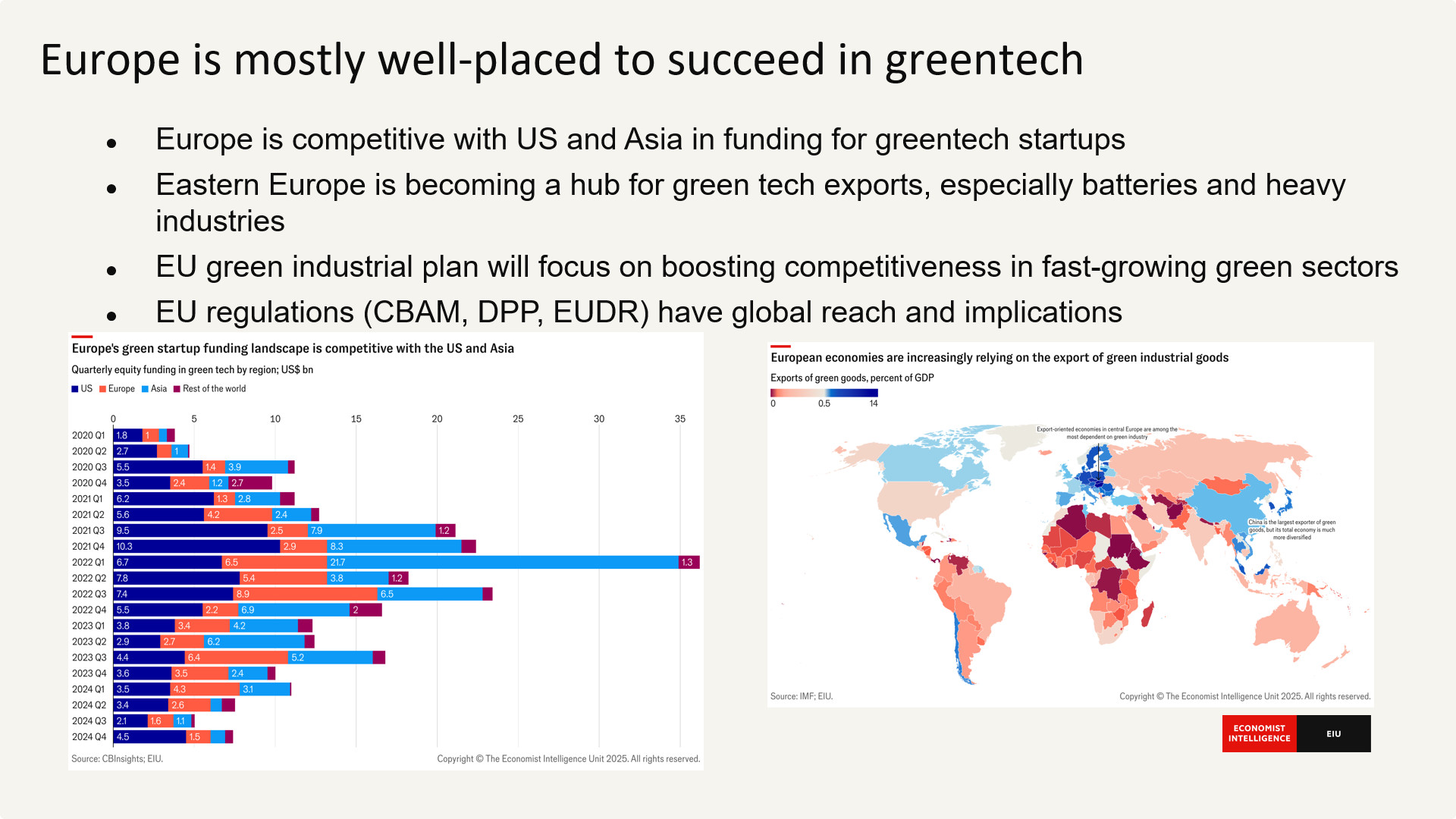
Europe is mostly well-placed to succeed in greentech
SOURCE: Driving Business Transformation in a Time of Global Change, The Economist Intelligence Unit, EIU
Digital Transformation: From Tools to Platforms
Although the focus of the tech and business worlds has largely shifted to AI, the term “digital transformation” was everywhere several years ago, and many organizations continue to pursue aggressive digital transformation strategies. However, the term can be somewhat slippery, and many have used it to simply mean “using digital tools,” which is reductive, considering that AECO organizations have been using digital tools like AutoCAD for more than 40 years.
In fact, “digital transformation” means not just the use of digital tools, but rather integrating tech into all areas of a business in ways that fundamentally change how a company operates and provides significant value. Organizations cannot achieve this level of transformation by adopting disconnected tech solutions. Rather, they need unified platforms that align their systems and processes, which are typically very fragmented.
The EIU writes in its transformation business briefing:
“Digital Transformation is all about data, and making sense of the huge amount of data companies, their suppliers, and their clients create every single day. Gaining the best insights is a must-have for every business, and we have gradually moved from a paradigm where companies thought it was too costly and complicated to one where companies understand how the technology can save costs as well as increase revenues.”
In the business briefing, the EIU uses cloud adoption as a proxy for digital transformation maturity. As with AI, the research found wide disparities between companies in various sectors and organizations of different sizes. While 78% of large enterprises are using the cloud, this number drops to 42% for small companies. And although 79% of information and communication companies have adopted the cloud, the numbers are much lower in manufacturing (45%) and construction (38%).
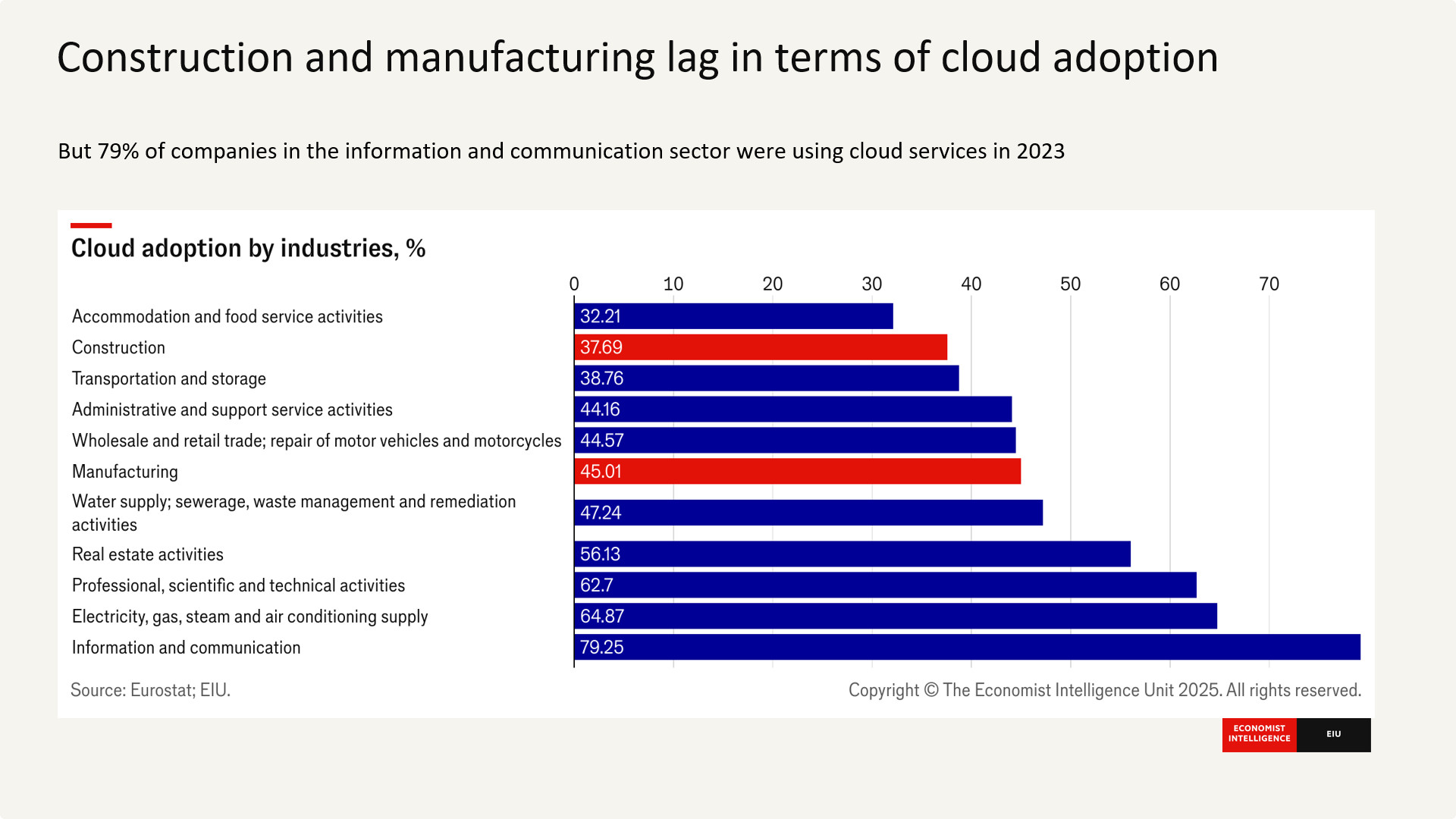
Construction and manufacturing lag in terms of cloud adoption
SOURCE: Driving Business Transformation in a Time of Global Change, The Economist Intelligence Unit, EIU
The Challenge Ahead
Although the EIU examines AI, sustainability, and digital transformation as separate forces, the truth is that they are deeply interconnected. For organizations in AECO and manufacturing, the difficulty lies not with simply adopting new technologies, but connecting the information produced by designers, engineers, operators, and digital systems in ways that both lay the foundation for AI adoption and accelerate sustainability progress. When companies can bring together these disparate data sources, they will be far better positioned to address these three major drivers of change to the global business landscape.
Turning Insight into Action
As AI adoption accelerates and sustainability requirements become stricter, many organizations struggle to connect fragmented data across their business. Learn more about how to prepare your organization for the forces driving global business transformation:
- Download the Economist Intelligence Unit business briefing.
- Watch the recordings from Autodesk DevCon 2026 here.