

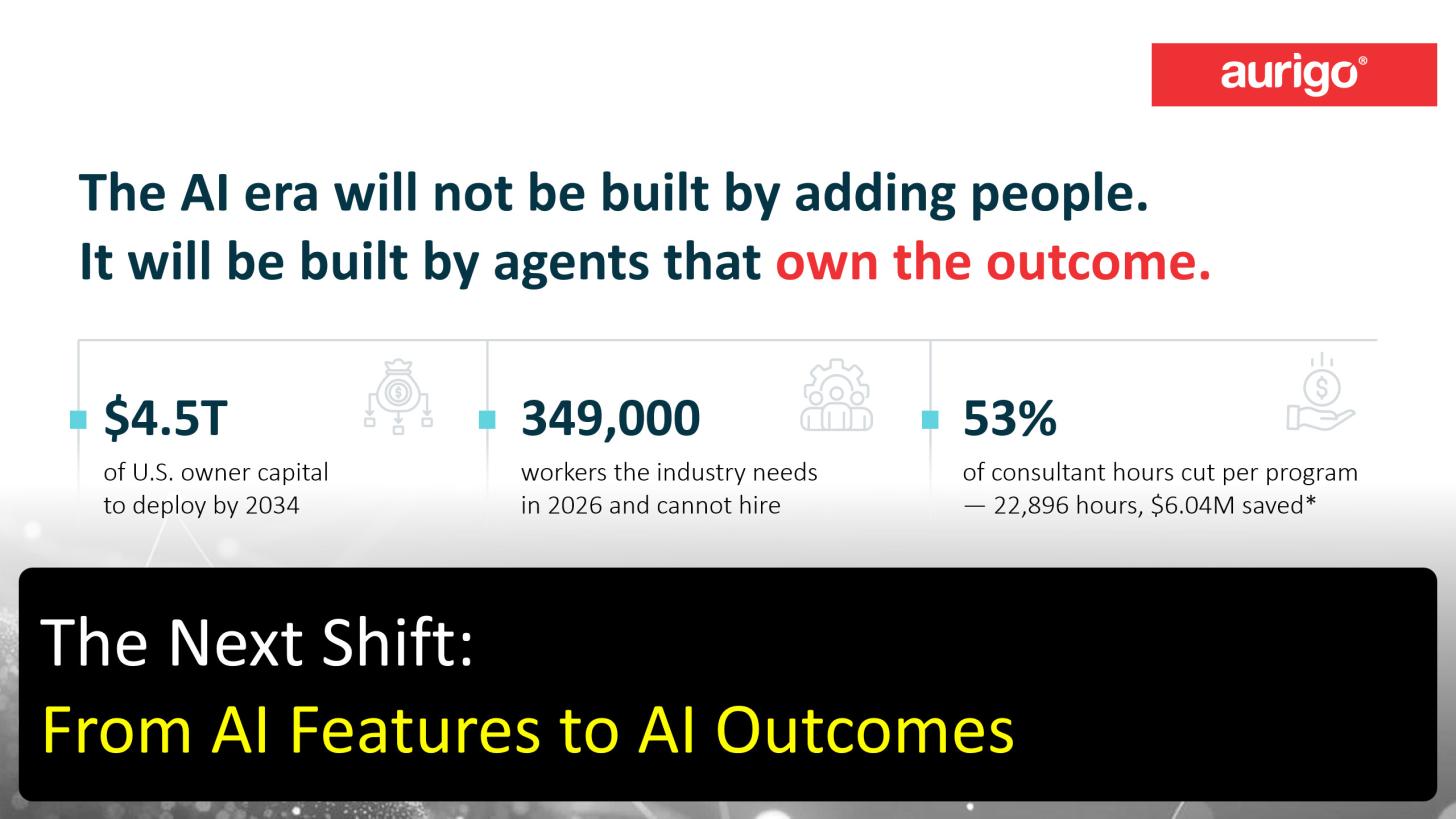
Software companies have rushed to deploy AI features over the past couple of years, with chatbots, summarization tools, and content generators showing up in everything from word processing programs to cybersecurity dashboards.
Often, these tools feel “tacked-on,” solving problems that users never considered particularly urgent. Even when the features are useful, they have so far mostly preserved the existing relationship between users and software: A person logs in and uses the application to get their work done (if maybe a little faster now, thanks to AI).
In this model, the software is still fundamentally a tool that employees operate, rather than something that can perform meaningful portions of the work on its own.
Balaji Sreenivasan, Founder and CEO of Autodesk partner Aurigo Software Technologies, sees a much larger opportunity.
Aurigo helps infrastructure owners plan and deliver major capital programs. Balaji says the company is now working to pivot its entire business away from being a system of record, toward becoming what he calls an “outcome-based company.” Rather than solely storing project information and making it easily accessible to human users, Balaji says, AI agents can increasingly perform meaningful portions of the work.
During a recent conversation, Balaji told me:
“You can’t just put an interactive natural language processor in front of your SaaS application and call it AI. That’s a big mistake that most SaaS companies are making, and it’s an approach that we didn’t take.”
According to Balaji, there is actually growing customer fatigue around solutions that merely make their own employees productive. He told me:
“Customers are demanding more outcome-based solutions, because they’re tired of needing to constantly get trained on the latest tech. They’re saying: ‘I don’t care about all of this changing technology. Give me the outcomes.'”
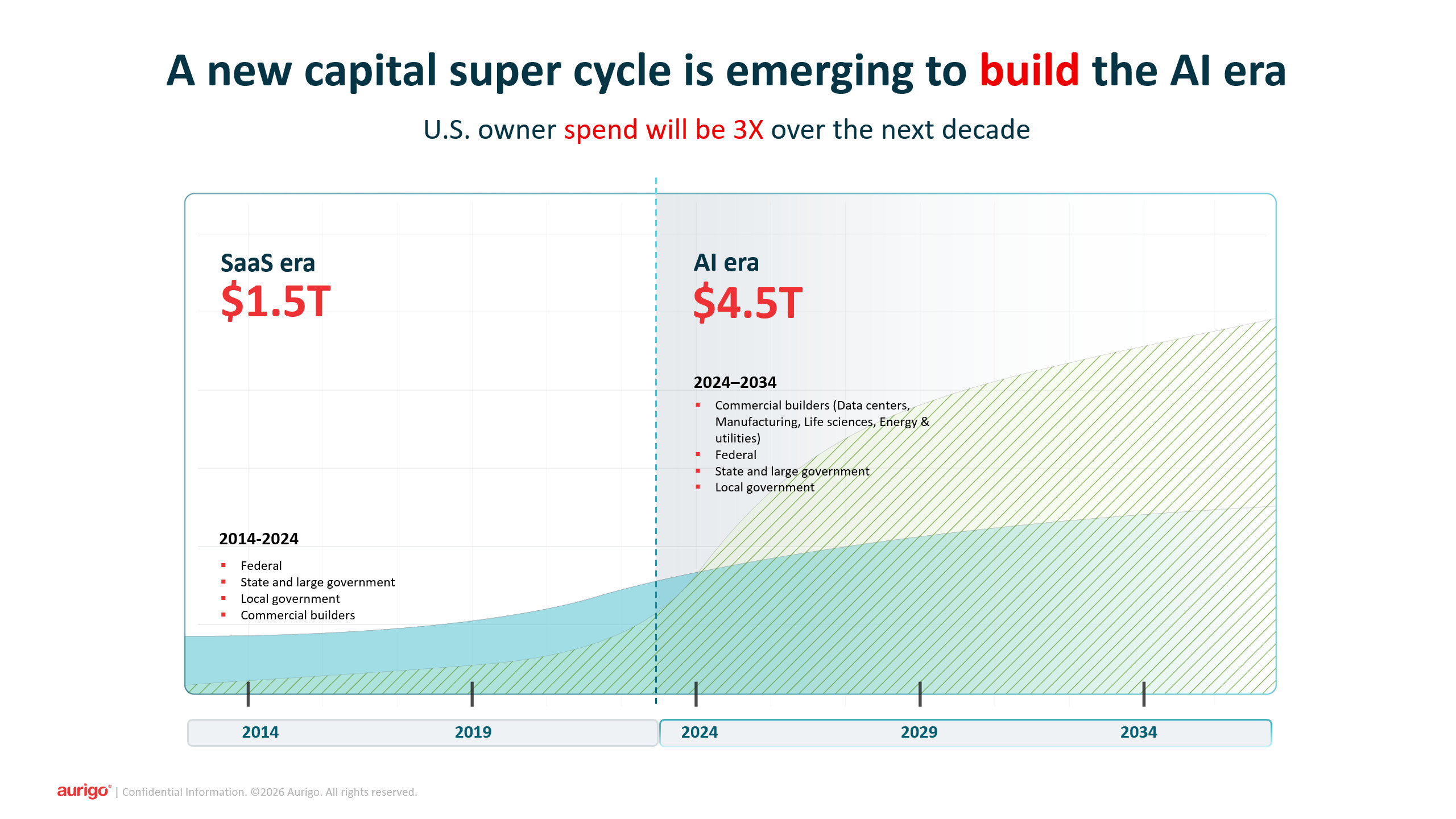
SaaS to AI capital super cycle
'Looking Around Corners'
In reinventing the company for the AI era, Balaji and his team recognized that one of Aurigo’s most valuable assets was its more than two decades’ worth of infrastructure data from real-world construction programs. The company used that information to build a unified data model that supports automated projections for project timeline, cost, and risk.
Aurigo’s software chooses among different AI models, depending on the complexity of the task, and then it synthesizes past data to 'look around corners' and estimate, say, the likelihood of a particular project getting hit with a major change order 14 months down the line. Balaji explained what that looks like in practice:
“As you’re working in the system, the agents are working in the background. They’ll pop up and say, ‘Hey, your project might actually run into trouble three months from now. Here are some action items that I think you should be taking. Do you want me to take care of that for you?’”
Then, Balaji said, the agents will resolve action items based on users’ instructions and report the results.
“Really, this is about turning that system of record into a more active, action-based platform, where our agents are working with you.”
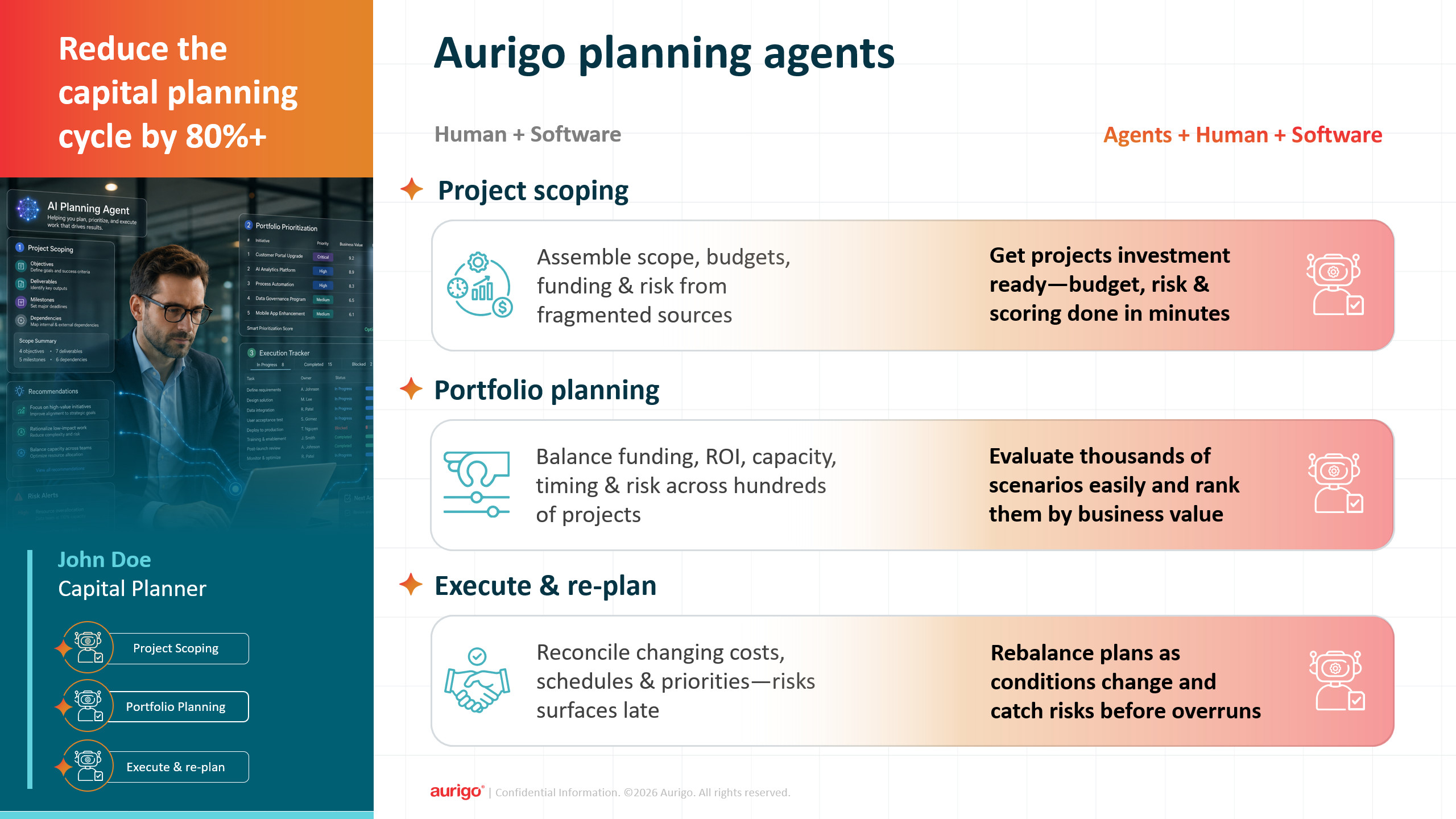
Capital planning cycle reduction by 80%
Agentic AI in Action
One of Aurigo’s customers, a large state department of transportation in the western United States, is currently evaluating Aurigo’s new agentic workflow for quantity takeoffs. Historically, staff at the DOT have manually reviewed design files to determine how much concrete, asphalt, steel, and other materials will be required to build a project. They then combine those quantities with current cost data and future cost projections to calculate the likely total cost of materials.
In the past, the quantity takeoff process for a single project has typically taken the state DOT around three weeks. Balaji told me that Aurigo’s AI agents can complete it in 20 minutes.
It’s an extraordinary result. But beyond the sheer time savings, I was intrigued by how Balaji framed Aurigo’s approach to the problem. He noted that the quantity takeoff process requires pulling data from design files, querying cost databases, applying inflation assumptions, and performing calculations. None of this work, he noted, requires human judgment. As he put it:
“There’s no inference. It’s just data.”
This is not yet a full production deployment, and the state DOT is still evaluating the agentic workflow. But Balaji noted that Aurigo has already validated the technology using actual field data.
“This is not a concept in a lab, It’s actually working.”
What Happens to Humans?
Balaji is essentially suggesting that project teams replace at least some labor with software. This is an example of what many are now calling 'service as software.' The term, a play on 'software as a service,' refers to a company selling a complete service or business outcome, with AI-native software performing much of the work that a human employee or contractor would have completed in the past.
Historically, he noted, around 16% of infrastructure project budgets have gone toward white-collar labor, with only around 1% set aside for software. Balaji sees tech spending rising to perhaps 4 or 5% of total project budgets, with per-project labor costs falling.
This exact scenario has, of course, been the source of much consternation over the past several years, as employees worry that they will be displaced by AI. But that’s actually not the outcome that Balaji foresees, even if he ends up being correct that AI agents will soon complete previously time-intensive project tasks in a matter of minutes.
Rather, he told me, many project owners currently don’t have enough skilled labor to deliver all of the projects already in their pipelines. When I asked him what would happen to the employees whose three-week quantity takeoff process could suddenly be completed in 20 minutes, he not only suggested that they would keep their jobs, but he told me that the state DOT would likely still be facing a labor shortage.
“The challenge the customer is facing is not to save time. They have a $1.6 billion program to deliver, and they need to wait for these 20 people to complete their work to get on to the next $100 million.”
He summarized:
“We are not removing and displacing any workers. We’re making the existing workers a lot more efficient. And now, the same 20-member team can support a much larger program.”
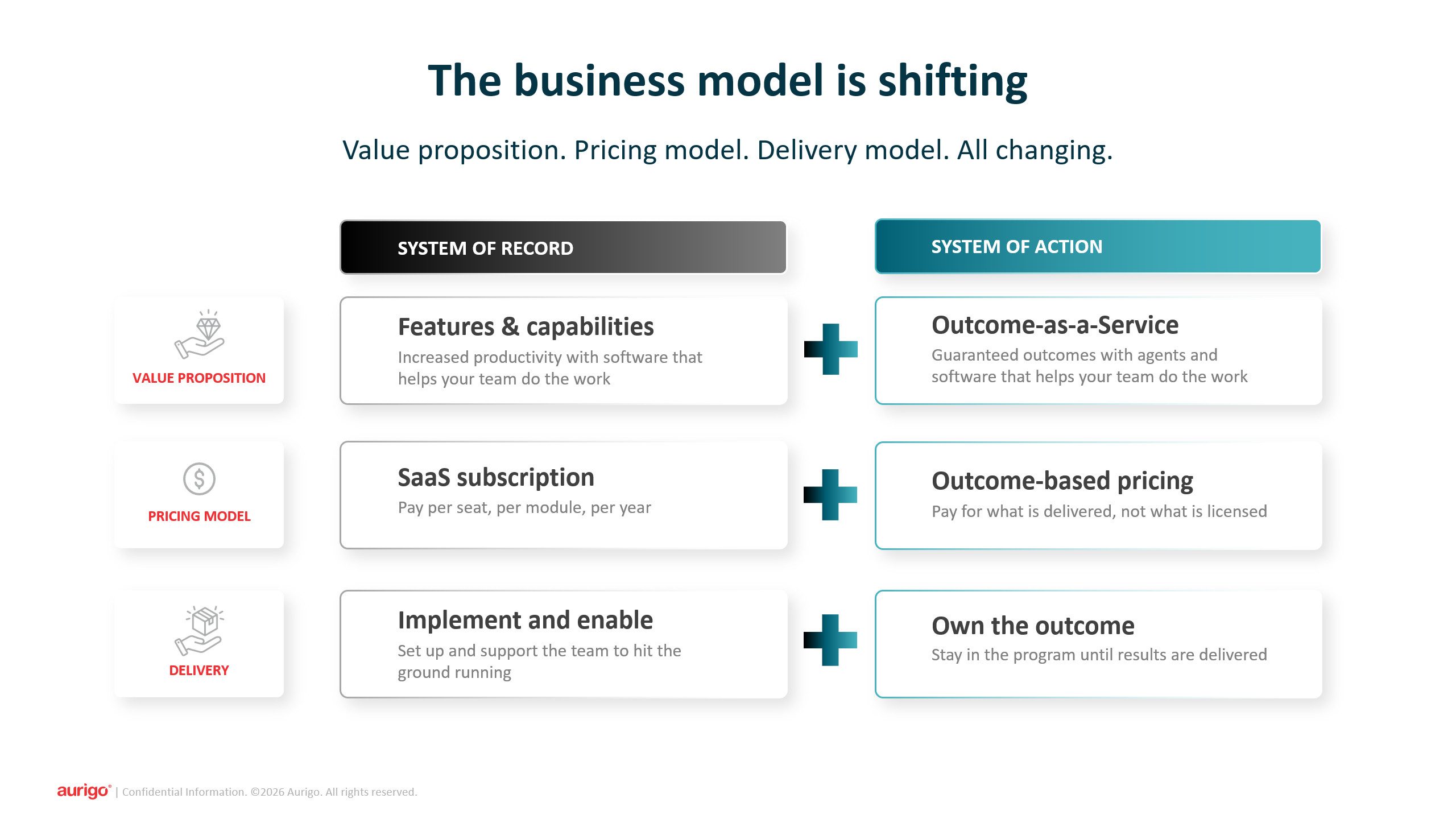
Value proposition, pricing model and delivery are shifting
A Question for You
Aurigo’s approach raises some interesting questions about the future of AI in infrastructure:
- Are customers already growing impatient with AI features, and instead looking for software companies to use AI to directly deliver outcomes?
- Which workflows in your own organization are most likely to be handled largely by AI agents in the future? (Think of processes that depend more on data and repeatable processes than on human judgment.)
- If AI-native software does begin to take on meaningful portions of the work, what will that mean for how we think about software budgets, staffing, and the value we expect vendors to deliver?
I would love to hear how you’re thinking about this shift in your own operations. Are you still mainly using AI tools to help people work faster? Or are you starting to hand over portions of the work to AI?