
If you've been building with Autodesk APIs for a while, you were probably familiar with the Autodesk App Store. It's been the place to find and distribute integrations built on top of Autodesk products for years.
In April we announced the launch of a new Design & Make Marketplace that replaces the App Store. It builds on the App Store foundation but now brings together more Autodesk solutions, more integration types, and increasingly, a new category of solutions that simply didn't exist when the App Exchange was created: MCP servers and AI-powered workflows.
And that's where things start to get interesting.
Discovery Is Changing
In the DevCon 2026 Keynote, Vikram Dutt talked about a future where AI agents become active participants in design and make workflows. Not just answering questions, but helping users connect systems, access expertise, and get work done across an increasingly complex ecosystem.
We're already starting to see that shift happen. For years, software discovery has been designed around people. You search, browse listings, compare options, and decide what to install. Agents don't do any of those things. They look for capabilities. They determine which tools can help solve a problem and how those tools fit into a larger workflow. That changes the discovery equation.
It's also one of the reasons MCP is generating so much momentum right now. By exposing tools and data through a standardized interface, MCP makes specialized capabilities easier for agents to find, understand, and use.
In that world, marketplaces become more than a catalog of software. They're a way of connecting expertise to the people, and increasingly the agents, that need it.
That's why the Design & Make Marketplace matters.
Autodesk is publishing its own solutions and MCP servers there, which creates a strong foundation. But the real value comes from the ecosystem.
Across design, construction, infrastructure, and manufacturing, there are companies that have spent years building deep expertise in highly specialized areas. As those capabilities become available through MCP, they become easier to access directly within the workflows where decisions are being made.
New in the Marketplace: RTLCA by NTI

A great example of this is RTLCA by NTI, which recently became available in the Design & Make Marketplace.
RTLCA connects Autodesk Forma and Autodesk Revit to a full building Life Cycle Assessment platform. Material data flows directly from the design model into RTLCA, analyses run automatically, and results come back into the workflow, including jurisdiction-aligned reporting. Because RTLCA is exposed as an MCP, an AI agent can call it mid-task. Instead of a designer stopping to run an LCA check, the analysis surfaces during the decision, as part of the workflow.
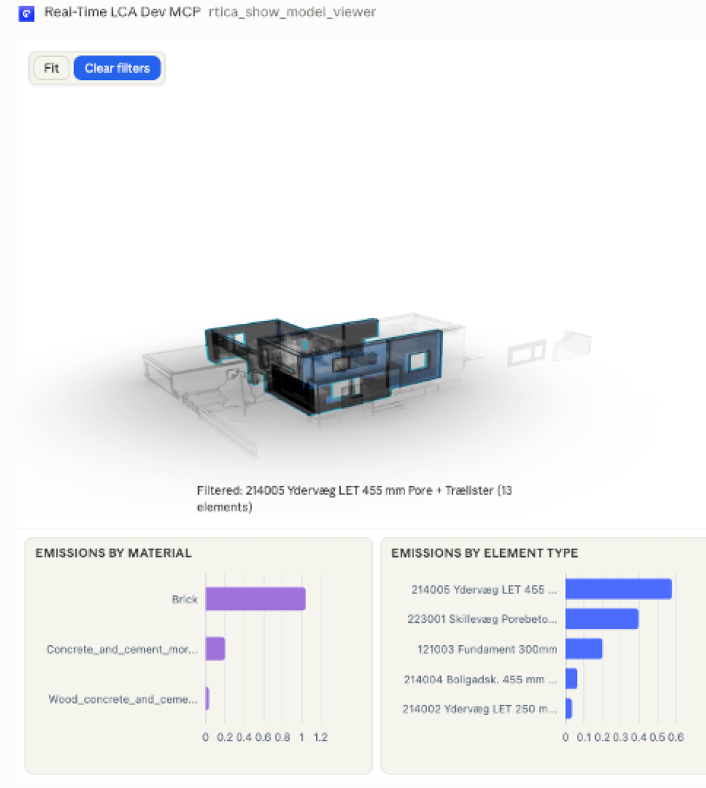
What caught my attention is that RTLCA goes beyond simply generating a sustainability score. Teams can drill into what is driving emissions, explore the impact of specific building components, and visualize those results directly against the model. Behind the scenes, a key part of the platform is its ability to map design data to environmental datasets efficiently, turning model information into actionable sustainability insights. It's the kind of specialized expertise that becomes even more valuable when exposed through MCP and integrated directly into design workflows — where an agent can reason with it to guide the next step. The difference is guidance like "reducing the window-to-wall ratio by 1.5% lowers emissions by 3.8%" arriving as a next step, not a separate report.
This is the kind of integration I think we'll see more of as the ecosystem evolves. Not just moving data between systems but bringing specialized expertise directly into the workflow where decisions are happening.
The Opportunity Ahead
If you've built a platform that solves real problems in design, construction, infrastructure, or manufacturing, now is a great time to think about how that expertise can become part of AI-powered workflows.
We're actively looking for developers and partners building MCP servers and agentic solutions that extend what's possible across the Design and Make ecosystem. If you're experimenting with MCP or building AI-powered experiences, we'd love to see what you're creating.