

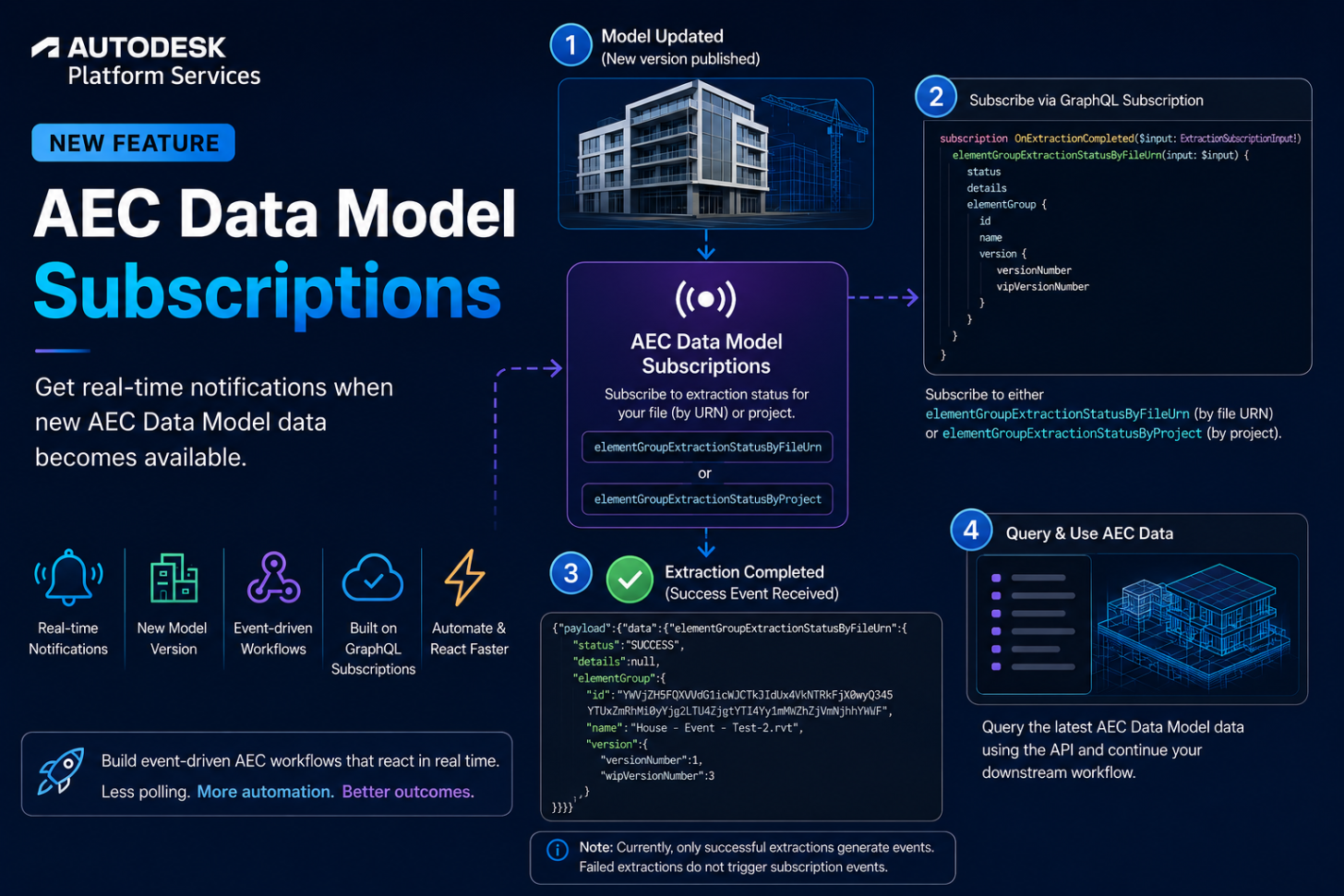
We’re excited to announce a new GraphQL Subscription capability for the Autodesk AEC Data Model API, now available in Public Beta.
With GraphQL subscriptions, applications can receive real-time notifications when new AEC Data Model data becomes available, enabling developers to build more responsive, event-driven workflows without repeatedly polling the API for updates.
Whether you are building automated model analysis, data synchronization, dashboards, quality checks, or downstream integrations, GraphQL subscriptions can help your application react to model changes as they happen.
Why subscriptions?
Until now, applications that needed to know when new AEC Data Model data became available typically had to periodically query the API and check whether a new version had been extracted.
GraphQL Subscriptions introduce a more event-driven approach.
Instead of continuously polling for changes, your application can establish a subscription and receive a notification when the extraction of a newly published model version has completed successfully. Your application can then use the AEC Data Model API to query the latest granular model data and continue its downstream workflow.
This can be particularly useful for workflows such as:
- Automatically refreshing dashboards when a new model version becomes available
- Triggering model validation or quality checks
- Synchronizing AEC data with external systems
- Starting downstream analysis or automation
- Keeping application data aligned with the latest published model information
How it works
AEC Data Model can now use GraphQL subscriptions to provide real-time notifications to your application.
A typical workflow looks like this:
- Establish a GraphQL subscription
Your application connects to the AEC Data Model subscription service and subscribes to extraction status events for the data you are interested in. - Publish or update a model
A new model version is published and AEC Data Model extraction begins. - Receive the event
When the extraction completes successfully, the active subscription receives an event indicating that the newly extracted data is available. - Query the latest AEC data
Your application can then use the regular AEC Data Model GraphQL API to query elements, properties, relationships, or other granular model information from the new version.
This enables a simple event-driven pattern:
Model update → AEC Data Model extraction → Subscription event → Your application → Downstream workflow
For the complete setup and implementation flow, see the AEC Data Model Eventing tutorial.
You can also review the AEC Data Model API changelog for details about this release.
Try the sample application
To make it easier to get started, we have created a sample application demonstrating how to work with AEC Data Model subscriptions:
GitHub: https://github.com/autodesk-platform-services/aps-aecdm-subscription-demo
The sample demonstrates the GraphQL subscription workflow end to end, including establishing the subscription, receiving extraction events, and reacting when updated AEC Data Model data becomes available.
Sample code note: The sample code was created with assistance from Claude Code and is intended as a reference implementation for learning and experimentation. It should be reviewed, tested, and adapted as appropriate before being used in a production application.
Current limitation
Because the AEC Data Model GraphQL Subscription capability is currently in Public Beta, there is an important limitation developers should be aware of.
At this time, subscriptions only send an event when an AEC Data Model extraction completes successfully. If an extraction fails, a corresponding failure event is not currently sent through the subscription.
Applications should therefore not assume that the absence of a success event necessarily means that extraction is still in progress. Depending on your workflow and reliability requirements, you may want to implement additional status-checking or timeout logic as a fallback.
We recognize that failure notifications are important for robust production workflows, and this is an area we are actively evaluating as the capability evolves.
We want your feedback
GraphQL subscriptions open up a new way to build event-driven applications on top of the AEC Data Model, and we would love to hear how you are using them.
Since this capability is still in Public Beta, developer feedback is especially valuable. We are interested in hearing about:
- The types of event-driven workflows you are building
- Additional events or subscription filters you would find useful
- Reliability and lifecycle requirements for long-running subscriptions
- Error and failure notification scenarios
- Developer experience improvements for the subscription API and documentation
If you try the feature, please share your feedback with the APS team through APS Get Help. Your input will help us shape the next iteration of AEC Data Model eventing.
Get started
Ready to experiment with event-driven AEC workflows?
- Explore the AEC Data Model Eventing tutorial
- Review the AEC Data Model Subscription changelog
- Try the AEC Data Model Subscription sample
We’re excited to see what you build with AEC Data Model subscriptions—and we look forward to your feedback.