

Last summer, the business world buzzed with the news of an MIT report that claimed 95% of AI pilots are essentially failing to create any value at all.
Every few months, a new headline highlights the challenges companies face as they seek to translate their AI investments into tangible business outcomes. At the same time, one of the pervasive narratives surrounding AI is the idea that the technology will replace entire business units with push-button production.
Perhaps unsurprisingly, the truth lies somewhere in the middle. Uncovering the reality requires us to look beyond the headlines and consider the details of how successful firms are using the technology. When I talk to our leading partners and customers, I often find that they’re having great success with AI. But that’s because their use of the technology is grounded in the real world. Instead of chasing sci-fi scenarios where AI agents replace their entire HR and finance departments, these companies are thinking carefully about how the technology applies to their very specific context. Yes, it’s fair to say that AI is transforming their businesses. But it’s even more accurate to say that AI is helping them to amplify what they were already doing at a world-class level.
Recently, I spoke with two presenters from the AI Leadership Forum lineup at Autodesk DevCon 2026 about their companies’ AI journeys. I left those conversations thinking there’s a blueprint for AI success that has nothing to do with replacing expertise.
‘This Will Become Huge’
During his Christmas holiday in 2022, Henri Veldhuis, Chief Digital Officer at Sweco Netherlands, read two articles on the same day about a new tool called ChatGPT.
“If you read something once, it could be a small, isolated incident. But if you read something twice, you think maybe something is happening.”
Henri created a ChatGPT account and started dabbling. At first, the resource-constrained tool kept booting him out of the system. But eventually, he got into the ChatGPT interface and gave it a coding problem. Almost instantly, he received an answer in JavaScript code, and he recognized that generative AI could have a very real impact on Sweco Group, Europe’s largest engineering firm. Henri said:
“This was something I had never seen. It was a tool that could create something that wasn’t there before. I realized: This will become huge.”
Soon after, Henri organized a COVID-era online hackathon. One Sweco engineer used ChatGPT to summarize 10 reports—a novel AI use case at the time. “That hackathon made a big impression,” he said.
Vladimir Koylazov, Chief Technology Officer at Chaos, a leading global 3D visualization, simulation and design companion software company, had a similar eureka moment when he used generative AI for the first time. He initially played around with ChatGPT, engaging it in exploratory conversations, simply trying to see how far he could push the tool, which didn’t even have image generation capabilities at the time. But at a company-wide event the next day, he told his staff: “The world today is different from the world yesterday.” Vladimir told me:
“I knew this was something different. I knew we needed to pay attention.”
AI in Action
Nearly everyone has a story about encountering generative AI for the first time. The difference is what Henri and Vladimir did next. Neither ignored generative AI, but they also did not try to remake their entire companies using AI tools. Instead, they each found targeted use cases and applications that would accelerate their existing workflows and set them apart from their competitors.
Sweco built its own large language model (LLM) called SwecoGPT on top of OpenAI’s technology. The tool tied into the company’s own data stores, making it easy for Sweco’s 23,000 experts to quickly get answers to questions about specific projects without reading and translating hundreds of pages of documentation.
Henri had modest aims at first. Rather than setting out to design entire projects using AI, he hoped that Sweco employees would use the tool to help them write emails, draft LinkedIn posts, and summarize dense documents. Currently, 90% of the company’s workforce actively uses AI.
“If everybody uses AI 10 or 15 minutes a day, we make huge steps as a company.”
This approach paid off as clients began to request AI capabilities for their own projects. Around six months after the debut of SwecoGPT, the firm landed a 100-million Euro contract with a client that specifically mentioned Sweco’s use of AI.
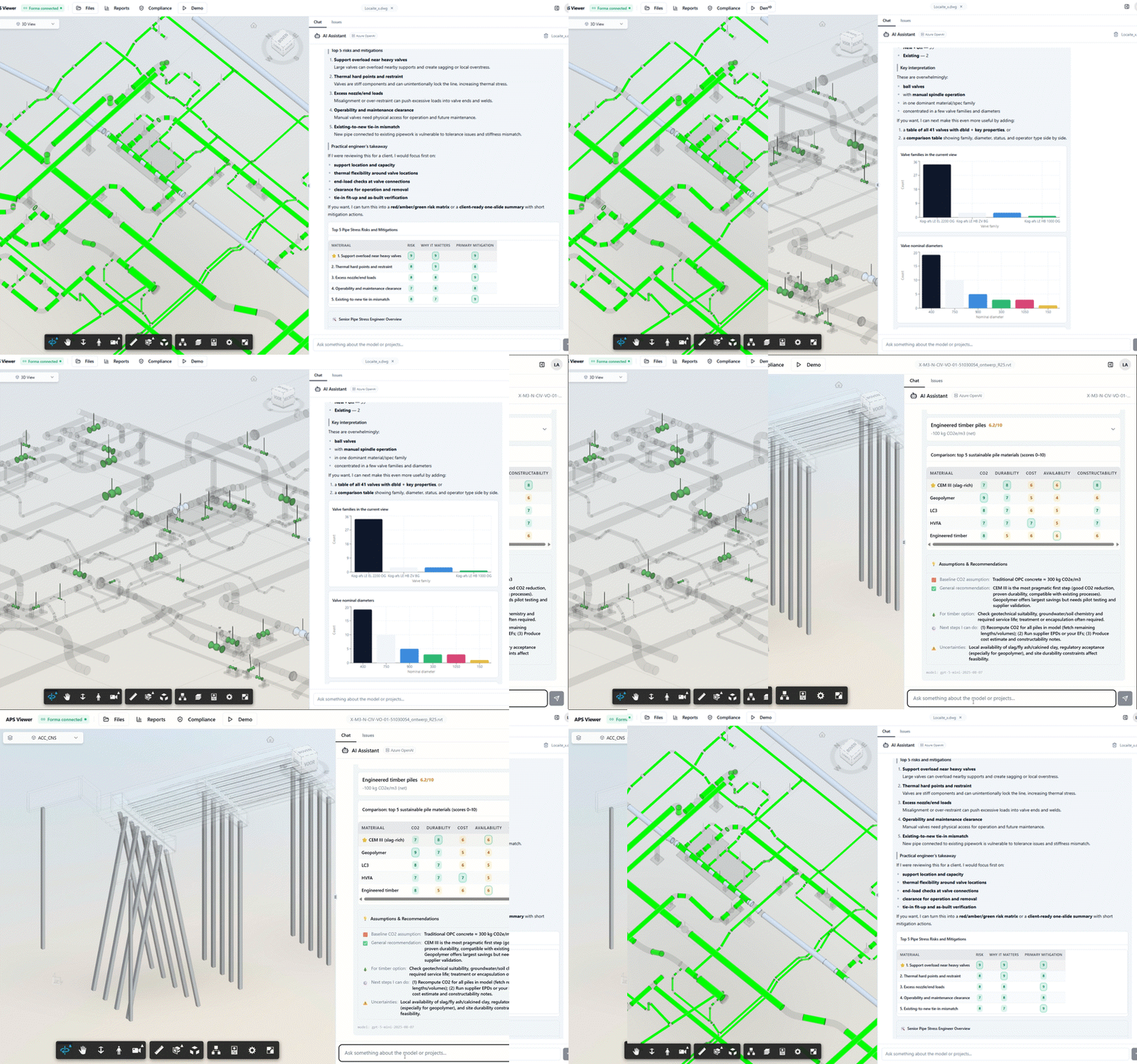
SwecoGPT empowers engineers to work faster, smarter, and with greater confidence by connecting AI to the firm’s collective expertise
For Vladimir and Chaos, the earliest AI success came with the release of an image enhancer for the company’s visualization software. The tool upgrades 3D renders of background elements in architectural drawings, such as people and vegetation, to make them look more realistic without changing the building design. This helps improve the quality of the images without forcing architects to spend hours modeling tiny details that aren’t actually relevant to their core work.
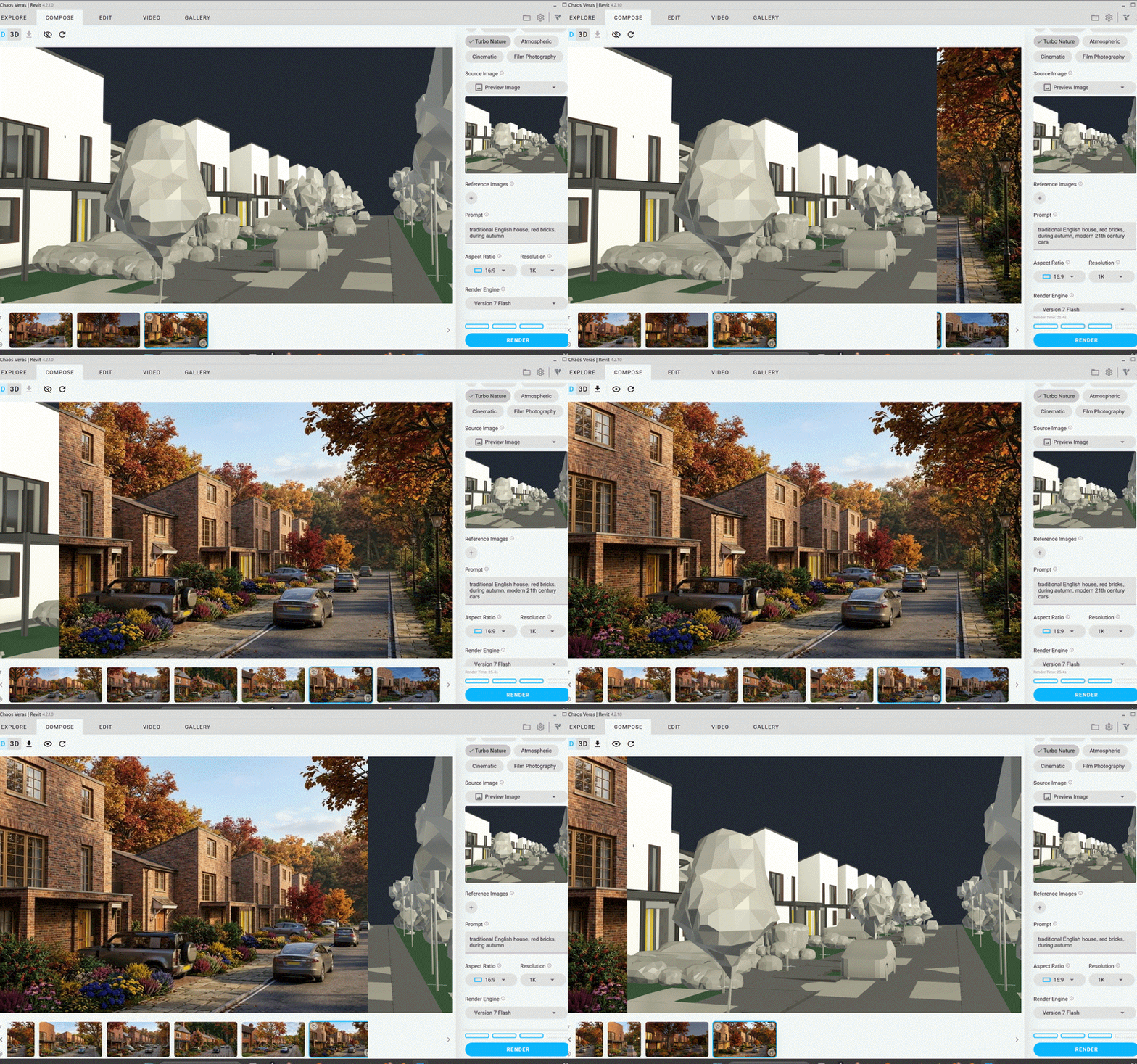
Chaos AI enables designers to generate complete design scenes instantly with simple prompts
Since then, Chaos has debuted AI capabilities that let clients generate short videos based on images, quickly create multiple versions of an existing design with different styles and materials, and turn rough sketches into vivid drawings during the early ideation phase. Chaos also uses AI internally to help teams write and review code more quickly.

Chaos introduced high-quality AI-powered conceptual design rendering to Autodesk Forma
Vladimir told me:
“Generative AI has democratized visualization. Until recently, the only way you could get a photorealistic render of something that doesn’t exist yet was to model it in 3D. Today, you can do this either with a quick sketch, or even a text prompt.”
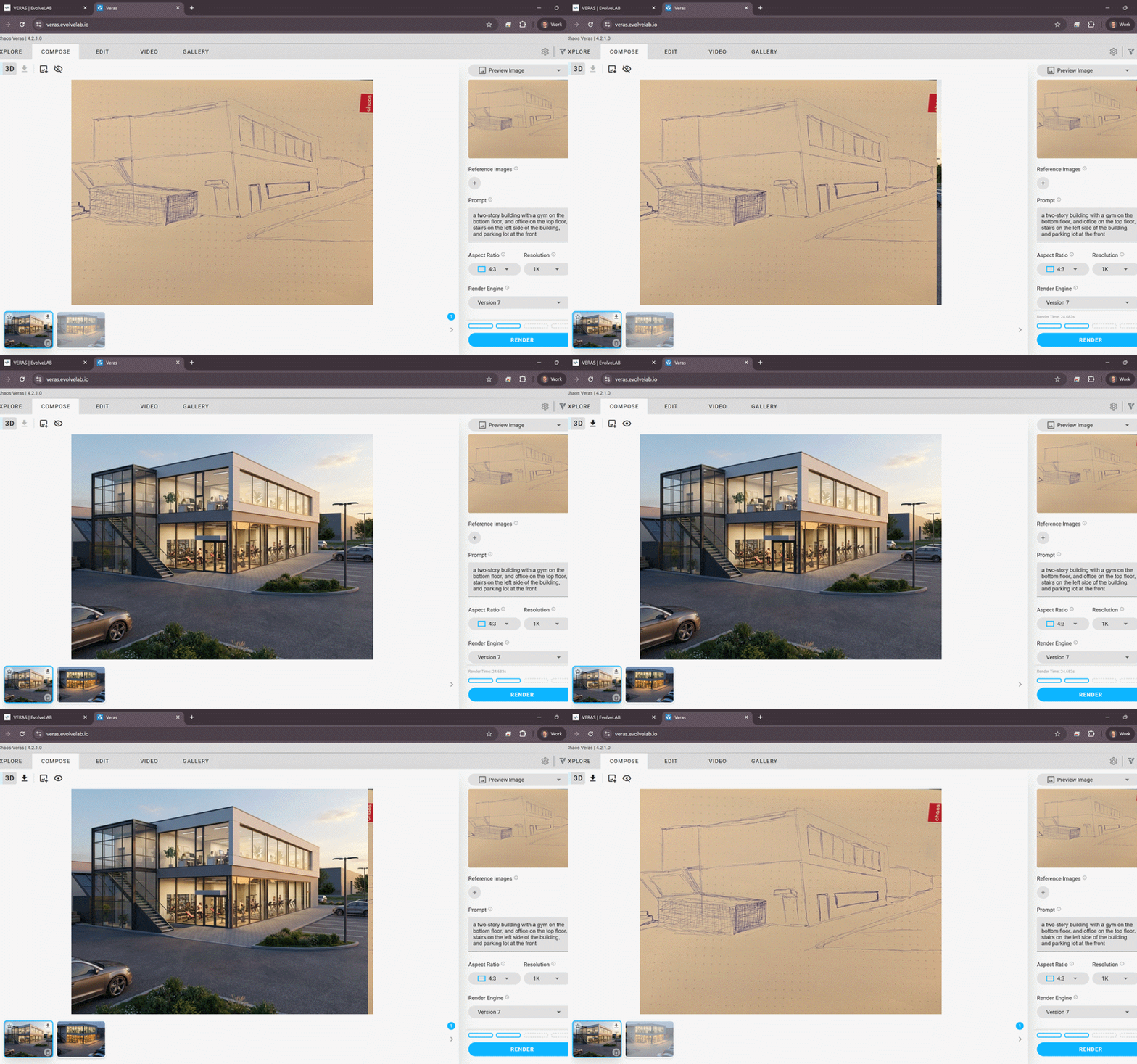
Chaos AI turns hand sketches into high-quality visualizations
It’s almost as important to note how these firms are not using AI. Sweco is not automating safety decisions, replacing engineers, or delivering outputs directly to clients without human review. And Chaos is not even thinking about giving customers the ability to generate final, build-ready architectural designs with AI. Both companies are using the technology to accelerate their work and explore more options, not to outsource their thinking or automate the generation of core deliverables. Vladimir said:
“Once you move beyond the ideation phase and you start working on an actual project, you need to be able to show exactly what is going to be built. Generative AI still has a tendency to hallucinate or change things from one version to another. In architecture, you need to be precise.”
Pushing the Boundaries
Looking ahead, Vladimir predicts that AI will help architects not only quickly create outstanding renderings, but also 3D virtual reality (VR) models that allow stakeholders to make simulated project walkthroughs. And although he does not believe the technology is anywhere close to automating architectural work, he says that it may soon help speed up the design for highly repeatable buildings such as schools.
Henri dismissed the idea that AI tools will be able to automatically design infrastructure or buildings as a “fantasy,” but he does think the technology will begin to make its way into human-led design processes. He said:
“Eventually, we want to use AI not to just check things, but to create new designs.
Even as AI makes people more efficient, Henri told me, he does not believe the technology will replace human experts or take work away from design teams.
“As we become more digital, we can achieve much better and faster results. That will only increase the number of designs a client wants. So, I'm not scared of losing business, or worried that our business will disappear. I think AI will only increase the demand for our services.”
What This Means for Leaders
At the FORTUNE-hosted AI Leadership Forum at DevCon, Henri and Vladimir shared how AI is helping firms accelerate design workflows, improve decision-making, and make better use of expertise across complex projects.
A Question for You
As AI becomes embedded into design and engineering workflows, the firms creating the most value will be the ones that use AI to amplify human expertise.
- How is your organization using AI to empower experts?
- Where could AI help your teams move faster or explore more ideas?
- What human expertise will become even more valuable in the age of AI?
If this resonates, I’d love to continue the conversation. The future of design and engineering will be shaped not just by AI, but by the people who know how to apply it thoughtfully.