About GraphQL
GraphQL is a query language for APIs developed by Facebook. It was used internally starting in 2012 and open-sourced in 2015. GraphQL is now maintained by the GraphQL Foundation, hosted by the Linux Foundation.
GraphQL provides a complete and understandable description of the data in an API. It can be thought of as an alternative to REST. You request data with queries and create, update, or delete data with mutations. Both follow the same syntax. GraphQL allows clients to request exactly the data they need—no more, no less.
The most common operations in GraphQL are queries and mutations.
What is a GraphQL Query?
Queries fetch data from the API. You can think of queries as equivalent to GET requests in REST APIs.
Note: For User Profile API, all GraphQL operations (queries and mutations) use the POST method. See API Basics for details.
What is a GraphQL Mutation?
Mutations modify data in the API. You can think of mutations as equivalent to DELETE, PUT, or PATCH operations in REST APIs.
What are the Advantages of GraphQL?
- Strong typing: GraphQL has strongly typed schemas with runtime datatype checking and field sub-selection.
- Multiple resources in one request: GraphQL can return data from multiple sources in a single round trip to the server.
- No over-fetching or under-fetching: Clients request exactly the fields they need.
- Introspectable and self-documenting: The schema describes all available types and operations.
- Versionless evolution: GraphQL provides tools for continuous schema evolution, avoiding the need for API versioning.
- Rich ecosystem: A large open-source community with implementations in JavaScript/TypeScript, Go, Ruby, Scala, Python, Java, and more. Popular frameworks include Apollo, AWS AppSync, Prisma, and Hasura.
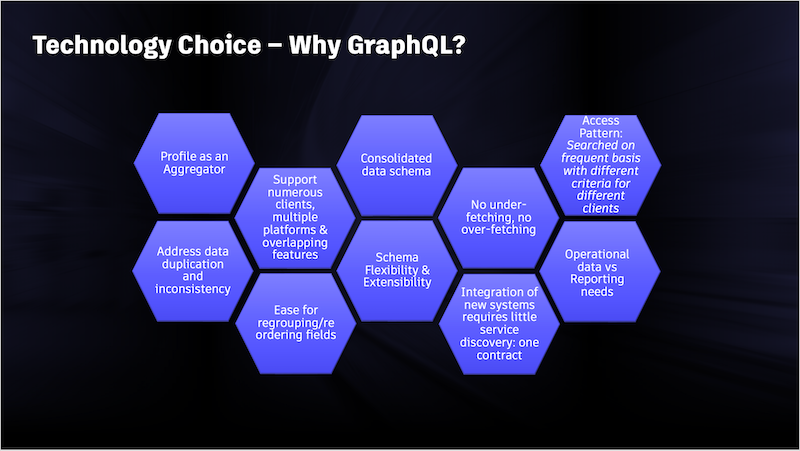
Why GraphQL for User Profile?
User Profile is an entity with significant potential for adding new fields as requirements evolve. GraphQL’s extensible schema makes it an ideal choice for this use case.
Key benefits for User Profile:
- Resolver-based architecture: GraphQL schemas are composed of resolvers, allowing data to be pulled from multiple source systems. This is especially useful for an aggregation layer.
- Efficient data retrieval: Multiple resources can be fetched in one round trip.
- Client control: Clients decide exactly which fields to query or update, without needing separate API endpoints or new API versions.
- Automatic validation: Runtime datatype checking ensures data integrity.
Additional benefits include minimal payload exchange, automatic self-documentation, and returning only explicitly requested information.